Guide Merchandise management system
Whether you’re a small retail store or an international eCommerce company, effective merchandise management is the key to smooth processes and satisfied customers.
More and more companies are using an ERP system to make processes more efficient, minimize errors and increase customer satisfaction.
In this guide, we take a closer look,
What is a merchandise management system?
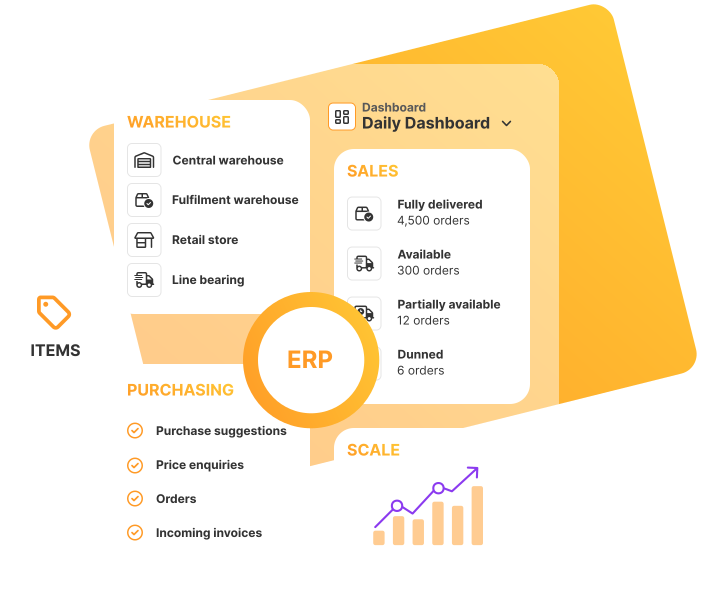
An enterprise resource planning system (ERP or WMS for short) is software that monitors and controls all goods flows in a company. By providing an overview of all goods movements, it creates the basis for efficient business processes.
What are the tasks and functions of merchandise management?
Merchandise management systems serve one central purpose: to organize the flow of goods in a company as efficiently as possible.
However, different systems differ in their functions. Some focus on the basics for optimizing the supply chain, while others are very comprehensive. It is often possible to scale the merchandise management software and thus adapt it step by step to new requirements. Internal and external systems can be integrated into the merchandise management system via interfaces, for example to cash register and store systems, tax consultants or online marketplaces.
The central components and functions of an enterprise resource planning system are as follows:
The three types of merchandise management system
In business management, merchandise management systems are generally divided into three types, which differ in terms of their functional scope and the integration of operational processes.
Open merchandise management system
An open merchandise management system only records the movement of goods at the company’s borders – i.e. goods receipts and goods issues. However, processes within the company, such as stock transfers between warehouses, production processes or stock changes due to internal use, are not recorded.
This system is particularly suitable for small retail businesses with manageable processes that do not require detailed mapping of the internal flow of goods. The focus is on documenting external flows of goods, for example for accounting or simple inventory control. However, as internal processes are not taken into account, the open ERP system does not provide a complete picture of the operational flow of goods and only enables limited business evaluations.
Closed merchandise management system
The closed merchandise management system records the entire goods cycle within a company – from ordering, goods receipt and warehouse management through to sales and reordering. It therefore maps all internal goods movements.
Such a system functions largely autonomously and covers all relevant areas of the company, such as purchasing, warehousing, production, sales and controlling. This complete integration creates a consistent information base that enables exact inventory management and precise determination of requirements. There are no external interfaces in a classic closed system, as all processes are handled within the system boundaries.
The advantage lies in the height of data consistency and the avoidance of information breaks; the disadvantage lies in the low flexibility in relation to external applications or partners.
Integrated merchandise management system
An integrated ERP system is a further development of the closed ERP system. It has the same comprehensive internal functions, but can also communicate with third-party systems and external partners via interfaces. This allows online stores, accounting systems, logistics service providers or CRM systems, for example, to be seamlessly integrated.
The height of scalability and industry-specific expandability make integrated systems the standard solution for modern companies. They enable central, networked control of all goods and information flows – from procurement to sales – and at the same time offer the necessary flexibility to react to individual requirements or market changes.
On-premise, cloud or hybrid
A distinction is also made between merchandise management systems according to their type of use:
On-Premise
The company owns the hardware and software and operates the system on its own server. This version has advantages, for example in terms of data protection and customizability. In addition, a stable Internet connection is not required to use the program. However, the acquisition costs are high. The same applies to the risk of updates being discontinued at some point.
Cloud
Cloud solutions are available regardless of location as soon as there is an internet connection. The system can usually be scaled flexibly and high acquisition costs are eliminated in favor of monthly fees. However, the data is not stored on your own servers.
Hybrid
Hybrid solutions, in which data is stored on your own servers and additional functions are booked in the cloud, combine the Good of both worlds.
Differences between ERP systems and merchandise management systems
Not all enterprise resource planning (ERP) systems are the same. The former focuses on the organization and control of goods flows. An ERP system offers additional functions for managing other resources. This often results in a digital image of all company processes.
In reality, the boundaries are becoming increasingly blurred. Most ERP systems now also offer ERP functions, for example for controlling and financial accounting. This means that when selecting a system, the question is less “ERP system or ERP system” and more “Which functions do I need for my company?”.
Advantages of a merchandise management system
Good merchandise management systems save time, reduce costs and give companies a competitive edge. The merchandise management system acts as a process accelerator in day-to-day business.
In detail, companies benefit from the following advantages:
Transparent inventories
Thanks to real time data, everyone in the company knows immediately which goods are available and in what quantities. Buyers can quickly take countermeasures in the event of impending bottlenecks. Sales staff can see at a glance which products are in stock.
Simplified communication and collaboration
Whether sales, in stock or purchasing: everyone accesses the same database. This eliminates queries and unnecessary waiting times. Information on orders, delivery times or returns can be called up at any time and is always up to date.
Less effort thanks to automated processes
A WWS takes over many recurring tasks. For example, the system automatically creates purchase order proposals, generates delivery bills or invoices returns. Employees are less occupied with routine tasks and can concentrate on more complex tasks.
Higher quality
Centralized data and standardized processes reduce the risk of errors. The high data quality enables faster and better decisions.
Efficient warehouse management
The software monitors stocks and schedules replenishments in good time. This means that overstocks and out-of-stock items remain the exception. Integrated functions such as inventory and stock valuation save companies additional effort.
More insight into finances and accounting
As every goods movement is documented in the system, a meaningful database is automatically created for cost and sales analyses. Controlling also benefits from transparent figures and precise KPIs.
Higher customer satisfaction
Fast deliveries, correct invoices and reliable information on delivery status increase customer satisfaction. With an inventory management system, there are also hardly any incorrect deliveries or other embarrassing mishaps.
Motivated employees
Efficient processes, more time for exciting tasks and satisfied customers: All of this also has a positive effect on employee motivation.
Sustainability through resource savings
Effective merchandise management enables companies to reduce resource consumption and protect the environment.
Overall, a merchandise management system serves as the engine of day-to-day operations. It automates routine tasks, ensures transparency and gives employees more room for strategic work. Companies increase their speed and improve the quality of their services.
Who needs a merchandise management system?
Every company that stores, sells or ships products benefits from merchandise management. Whether you are a regional retailer or an international online retailer – as soon as orders arrive, goods are moved or returns are processed, merchandise management brings many advantages.
Start-ups and young companies
A merchandise management system helps start-ups to establish clearly structured processes and make optimum use of resources right from the start. This minimizes sources of error before the business really takes off. At the same time, the system creates the basis for successful growth because it ensures positive consumer experiences. Another advantage: young managers, who often lack experience, can make decisions based on reliable data.
Small and medium-sized enterprises (SMEs)
Time and personnel are scarce in small companies. Manual tasks such as creating stock lists in Excel or order processing take up valuable time that is not available for other tasks. With an inventory management system, existing employees can concentrate on areas such as product development, service and growth. This reduces stress and increases motivation and quality.
Larger companies and groups
In larger companies or branch networks, merchandise management is mandatory to ensure smooth cooperation between departments and locations. Automated processes save valuable time. The central database prevents misinformation and reduces costs through precise inventory management. As a rule, large companies use a comprehensive ERP system.
ECommerce and multichannel retailers
Retailers who sell via different channels at the same time, for example in their own online store, on online marketplaces and in retail stores, also benefit massively from an inventory management system that keeps stocks synchronized. This is the only way to maintain an overview, avoid overselling and offer customers fast deliveries.
B2B companies
A complete overview of raw materials, semi-finished and finished goods plays a central role, especially in wholesale or in manufacturing companies. Here, merchandise management ensures a smooth flow of materials and reliable delivery dates.
Practical examples of the use of merchandise management
The following practical examples illustrate how merchandise management systems master and solve different challenges.
Online retailer with multichannel sales
Initial situation
An online retailer sells its items both via its own shop and via marketplaces such as Amazon or eBay.
The challenge
Without a central overview, there is a risk of overselling as stocks are not reconciled in real time. Customers receive the ordered goods late. This affects their satisfaction and your own image.
Solution
An inventory management system bundles all sales in one system. Stocks are updated in real time and automatically synchronized across all channels. This results in fewer cancelations. Customers receive their goods faster and the retailer saves time when processing orders.
Initial situation
A local store expands its reach with an online store.
The challenge
Staff maintain items and prices twice, in-store and online. This leads to errors and makes it difficult to ensure uniform pricing and product ranges.
Solution
The merchandise management system serves as the main data source (PIM) for all item details and prices. As soon as something changes, for example discount campaigns, the data is automatically transferred to the online store. The team now only works in one system. Prices and product information are always up-to-date and identical – whether in-store or online.
Initial situation
A manufacturer produces components for industry. Materials and semi-finished goods are stored in several warehouses.
The challenge
There is no overview of available raw materials. There are repeated supply bottlenecks for important parts, which have an impact on production and deliveries to customers.
Solution
The system records material stocks and integrates production planning. It suggests repeat orders in good time and provides a better overview of production stages. This results in fewer production stops and reliably predictable delivery times.
Initial situation
A wholesaler supplies various branches and external customers. The quantity of items is large and each branch has separate warehouses.
The challenge
Employees at different locations often don’t know what the others have in stock. Stock levels are difficult to control, resulting in surpluses and duplicate orders.
Solution
The system networks all stores and storage locations. Employees can see in real time which items are available at which location and can easily transfer stock. The risk of shortages or emergency purchases is reduced. Unnecessary stock surpluses can be reduced.
Initial situation
An eCommerce company would like to remove its warehouse and shipping management from stock to a fulfillment service provider or via drop shipping.
The challenge
With external warehousing and shipping processes, it is easy to lose track of stock levels and sales order status. Customer complaints are difficult to track.
Solution
The merchandise management system integrates the fulfillment service provider directly via an interface. Stocks and shipping information are continuously synchronized. The retailer is always informed about stock movements and can provide information directly in response to customer inquiries. This results in fewer returns and higher customer satisfaction.
Organize finances and accounting with an enterprise resource planning system
A functioning and reliable accounting system is the backbone of every company. But without reliable data from purchasing, warehousing and sales, financial management becomes a game of roulette. This is where a merchandise management system or ERP system plays a crucial role.
This applies in particular to the following areas:
Central recording of incoming and outgoing invoices
The software records all goods movements and automatically generates accounting documents for purchasing and sales. At the touch of a button, you can see which payments are outstanding or have already been settled.
Automatic payment processing and dunning runs
A modern merchandise management system takes over the entire payment processing. It reconciles incoming payments and automatically starts multi-stage dunning processes as soon as deadlines are exceeded. This saves time and enables complete payment control.
Integration with accounting software
An ERP system can often be linked to standard accounting software (e.g. via DATEV export). This reduces the manual effort involved in data exchange and prevents errors due to multiple entries. At the same time, tax consultants or internal accountants benefit from consistent data.
Value added tax and other tax aspects
The automatic recording of all sales and costs makes it easier to keep track of tax-relevant transactions. The software assigns tax rates, which ensures an accurate tax return at the end of the year.
Liquidity planning and controlling
Seamless recording of income and expenditure in conjunction with current stock levels enables precise controlling. Companies can plan their liquidity, identify bottlenecks at an early stage and take countermeasures in good time.
Support with reporting and annual financial statements
An inventory management system provides key figures for reporting such as stock value, turnover per product category or contribution margins. The result is a transparent overview of the company’s financial situation.
A well-integrated ERP system relieves accountants and financial managers of a lot of work. It ensures up-to-date, correct data and thus supports the planning and management of company finances. From the automatic generation of invoices to the export of accounting data – thanks to a professionally organized ERP system, finance and accounting run smoothly and create the basis for strategic decisions.
How do I integrate merchandise management into my company?
The successful introduction of an ERP system depends on clear goals, structured processes and good communication. We recommend the following steps to ensure a smooth transition to the new system:
1. define goals and requirements
First of all, it is important to record the current status of your own processes – from ordering to delivery (as-is analysis) – and to determine which core functions are essential for your own business (target concept). Does the company need a classic merchandise management system or an ERP system? Which interfaces are important for processes or could become important in the near future?
2. form a project team
In the second step, companies should put together a team from different departments so that all requirements are taken into account.
3. system selection and planning
Different solutions must be tested in terms of functionality, interfaces, support and scalability. Once a system has been selected, the project plan can be drawn up.
Important: We recommend calculating costs realistically and allowing enough time to thoroughly test the system and train employees. Which external systems (e.g. store, marketplaces, accounting) should be integrated and what is the ideal data flow?
4. technical preparation
Are your own hardware and existing networks up to the requirements of the WWS? Cloud solutions often eliminate the need for large investments in your own servers. In any case, it is necessary to set up the required connections (e.g. to store systems, supplier portals, shipping service providers) in advance.
A separate test installation helps to simulate processes without jeopardizing day-to-day business.
5. data migration
It is best for companies to carry out a data cleansing process before transferring data to the new system. They can then transfer items, customers and suppliers to the ERP system and check whether all the information is stored correctly. Trial orders, returns and purchase orders can be used to ensure that the data is processed correctly.
6. training of employees
Practical training on specific processes ensures that employees quickly recognize the added value of the system and gain confidence in using it. This includes documentation or videos with the most important steps.
Important: Ideally, companies should set up a contact point that employees can turn to with questions and problems even after the introduction.
7. go-live and optimization
In order to have sufficient capacity, companies plan a fixed date for the official launch and reduce the number of other projects for this time. Particularly in the initial phase, it is important to closely monitor data flows and processes in order to quickly correct any errors. Workflows should also be regularly adapted when requirements change or new functions become available.
8 Acceptance and further development
After the go-live, there is time for continuous further development. Good conditions for this are created by an open exchange within the team. As soon as the company grows or new requirements arise, it may be necessary to plan system updates or the use of additional modules.
Costs and selection criteria for merchandise management
The cost of a merchandise management system (MMS) varies greatly and the available budget naturally plays an important role in the selection process. However, aspects such as range of functions, scalability and services are at least as important.
The following checklist will help you make the right decision:
1. all important functions and interfaces included
Does the system have all the necessary functions? Does it provide suitable interfaces to your own online store, marketplaces and other important tools (e.g. accounting or CRM)? This is the only way for companies to benefit from consistent processes without manual double entries.
2. compatibility given
Will the system run on the existing hardware and IT infrastructure or are additional resources required? With cloud solutions, it is important to check the stability of the internet connection and security aspects to avoid any nasty surprises.
3. expandable
A company’s requirements can change quickly: It may then be necessary to add new functions or integrate additional sales channels. A modular, expandable merchandise management system provides the necessary scope. This means that new modules or add-ons can be added as required without having to replace the entire system.
4. sufficient power
The performance of the software is important so that bottlenecks do not occur even with many simultaneous users or high data volumes. We recommend paying attention to scalability and checking whether the capacity of the desired system matches your own growth targets. A high-performance system saves time, reduces stress and increases team satisfaction.
5. user-friendly
An intuitive interface and clear menu navigation promote acceptance within the company. If the system is self-explanatory, companies save on training costs and employees can work productively more quickly. The best way to find out how user-friendly the system really is is to carry out practical tests.
Tip: Reviews from other users give a first impression of the user-friendliness of merchandise management systems.
6. suitable price-performance ratio
In addition to the license and implementation costs, it makes sense to factor in future expenses such as maintenance fees, possible updates or additional modules and weigh these costs against the expected process improvements. Good value for money is demonstrated by the fact that companies save time and money in the long term – and at the same time benefit from a system that is flexibly tailored to their needs. An ERP system often pays for itself quickly.
7 Good service
Finally, support plays a role. After all, fast, competent help with problems is not only important in the initial phase. In this case too, it is worth keeping an eye on tests and user experiences.
Conclusion: How to get started with merchandise management
Merchandise management system, yes or no? For many modern companies, the answer to this question is clear.
A merchandise management system or ERP system is far more than just software for managing stock. It optimizes the interaction between many areas of the company: from purchasing to sales to accounting. Start-ups and SMEs also save time and costs, prevent errors and ensure satisfied customers and motivated employees.
In order for companies to benefit from these advantages quickly, it is best to pay attention to criteria such as a suitable range of functions, scalability and reliable service when selecting merchandise management software. Not only the here and now, but also their goals for the coming years play a central role.
We also recommend following our tips when implementing an ERP or ERP system and continuously optimizing the system. This will transform your ERP system into a reliable long-term growth driver.