Guide Warehouse management
Once the order has been placed, the actual work process begins. Regardless of the size of the company – from small online retailers to large logistics centers – goods must be stored, commissioned and shipped efficiently. Structured warehouse management ensures that items can be found quickly, packed correctly and dispatched on time. This is supported by pick lists, data reconciliation and software solutions that automate and simplify processes.
Precise and reliable processes are particularly important in eCommerce. Customers expect punctual delivery and a smooth process. If stock is not recorded or reordered on time, the warehouse can quickly become a bottleneck and affect the entire supply chain – with negative consequences for customer satisfaction and business success.
This guide provides an overview of the central tasks of warehouse management. It explains how planning and organization in the warehouse can be optimized and what contribution modern warehouse management systems make to increasing efficiency.
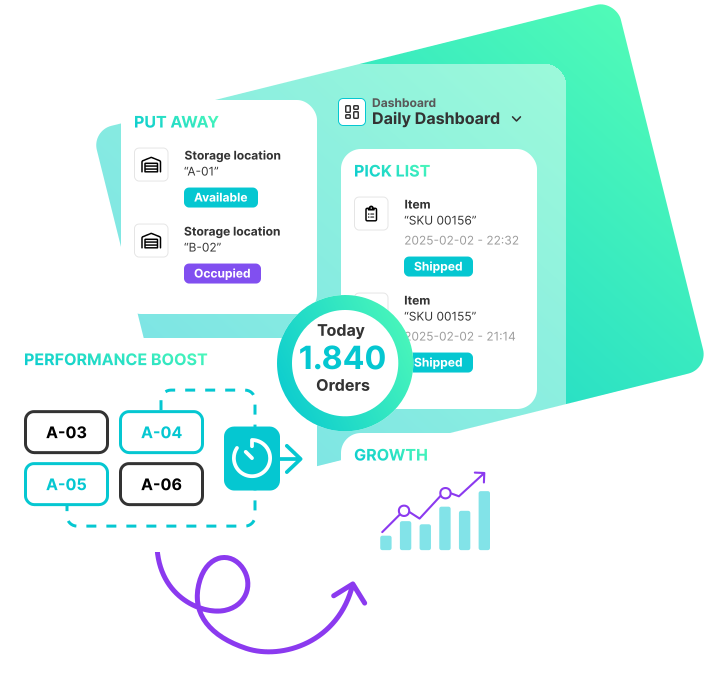
Warehouse management refers to the systematic organization, management and control of all goods movements within a warehouse. It ensures that stocks are up-to-date and correct, that sales orders are processed on time and that processes from goods receipt to dispatch run smoothly.
For online and mail order companies, warehouse management is more than just an internal support function: it is the logistical backbone of the business model. Delivery times, availability, shipping quality and returns processing have a direct impact on customer satisfaction, customer reviews and repurchase rates.
In practice, it is helpful to distinguish between warehouse management systems (WMS) and warehouse management systems (WMS). A WMS focuses on the management of stocks and storage locations. A WMS goes further: it controls operational processes (e.g. replenishment, order preparation), coordinates resources, provides reports and integrates into the system landscape (ERP, stores, marketplaces, shipping service providers).
The higher the sales order volume and product range, the more worthwhile the move from manual management (Excel, simple tools) via a WMS to a high-performance warehouse management system.
The central tasks of a modern warehouse organization
An efficient warehouse organization has a simultaneous effect on speed, quality and costs. It creates structured, repeatable processes and reduces search times, distances and incorrect bookings.
Goods receipt and storage
The warehouse process begins with incoming goods: deliveries are logged in, accepted, checked and received. This includes quantity and quality checks, recording batches, serial numbers or best-before dates, creating labels and posting to the system.
This is followed by storage (putaway). Modern systems suggest suitable storage locations based on defined rules (dimensions/weight, ABC/XYZ class, hazardous goods, temperature requirements). The goal: short distances, sensible documents and fast availability. Properly controlled goods receipt is crucial for stock accuracy and shortens the dock-to-stock time.
Replenishment, order preparation and shipping
Replenishment control ensures that picking stations are supplied on time and in the right quantities. It can be minimum value-based (min/max), consumption-based or dynamic.
Order preparation is often the biggest time and cost factor. Depending on the order structure, different methods are suitable: single-order picking (simple, flexible), batch picking (several orders in one run), multi-order picking (parallel compilation for many orders), zone picking (division of the warehouse into zones) or variants with consolidation or put-wall steps.
The aim is to minimize distances, reduce picking times and avoid errors.
Shipping includes packaging, documents (e.g. customs), labeling, carrier selection (rate shopping) and handover. Clear cut-off times and exception rules (shortages, address problems) stabilize performance.
Returns management and quality assurance
Returns are unavoidable in the mail order business and hold potential: they provide information on product quality, packaging suitability, item descriptions and picking errors.
A standardized returns management process – also known as the RMA process (Return Merchandise Authorization) – covers the following areas: Logging in, identification, condition inspection, decision on restocking, refurbishment or segregation. This process makes it possible to plan returns.
Quality assurance (e.g. spot checks, initial sampling, photo documentation) should be carried out in all process steps. This reduces error rates and increases the perfect order rate.
From warehouse organization to a digital system
With growing sales order volumes and an increasing variety of items, manual processes quickly reach their limits. Excel lists, paper-based documents and verbal reconciliations can ensure neither speed nor transparency – on the contrary: stocks drift, search times increase and control becomes reactive.
This is where a warehouse management system (WMS) comes in: It digitally maps all warehouse movements, provides real time transparency and automatically controls operational decisions: Where is storage to take place? Which route does the picker take? Which sales orders are bundled? What replenishment quantity makes sense?
Comparison: Manual warehouse management vs. warehouse management system
Transparency
In manual processes, inventory management is usually carried out in tables or separate files. These have to be updated manually on a regular basis, which leads to time delays and errors. In a WMS, all goods movements (storage, transfer, order preparation, shipping) are recorded in real time.
Each SKU is linked to its storage location, stock, status (e.g. reserved or available) and, if applicable, batch or serial number. This gives management a consistent view – not only of items, but also of open sales orders, backorders and exceptions.
Error rate
In a purely manual environment, many errors occur due to double entries, transposed numbers or forgotten bookings. A WMS significantly reduces these risks: each process step is automatically confirmed via bar codes, QR codes or RFID tags (transmit/receive transponders).
Plausibility checks – for example for incorrect quantities, inappropriate storage locations or missing serial numbers – ensure that discrepancies are detected and reported immediately.
Scaling
A static warehouse layout and firmly defined workflows quickly reach their limits as soon as stocks grow or new sales channels are added. A WMS works with dynamic strategies:
- Slotting: Automatic placement of items based on access frequency and dimensions.
- Waves (picking waves): System bundling of similar sales orders for efficient processing.
- Prioritization: Preferential treatment of time-critical orders (e.g. express, click & collect).
This flexibility makes it possible to make optimum use of storage capacities, absorb seasonal peaks and adapt processes without having to completely redesign them.
Reporting
Manual warehouse management usually only generates individual reports – e.g. daily stock lists – without in-depth analysis functions. A WMS, on the other hand, provides an interactive dashboard that displays KPIs (key performance indicators) in real time, graphically displays trends and enables drill-downs (targeted detailed analyses).
This allows the causes of deviations to be quickly identified and operational decisions to be made on the basis of constantly updated data.
Important key figures and success factors in warehouse management
A professional KPI system is the warehouse management’s navigation tool. It translates process data into assessable results and shows whether resources are being used efficiently. Only what is measured can be improved – and only what is comparable can be controlled. In practice, the following KPIs (Key Performance Indicators) are used most frequently:
Pick rate (positions per hour)
Shows how many item positions an employee commissions in one hour. A high value indicates optimized routes, ergonomic reach heights and good batch strategies. Improvements can be achieved through layout optimization, scanner support or multi-order picks.
Order Cycle Time
Measures the time from order receipt to dispatch. It includes confirmation, order preparation, packaging and handover to the carrier. The aim is to achieve a stable, plannable throughput time, taking cut-off times into account. Automated priority control in the WMS reduces peaks and delays.
Inventory Accuracy
Shows how closely system and actual stocks match. Deviations are caused by incorrect postings, mix-ups or unposted stock transfers. With cycle counting (permanent inventory in sub-areas), an accuracy of over 98 % can be achieved.
Perfect Order Rate
Indicates the proportion of error-free, complete and punctual deliveries. It combines several criteria and is regarded as a key quality indicator. A value above 95% is an indicator of mature processes and a high level of customer satisfaction.
Dock-to-Stock Time
Time span from unloading to availability in the system. The shorter this time, the faster the goods are ready for sales orders. Automated incoming goods inspections and RFID tracking significantly shorten this process.
Return rate
Indicates the proportion of returns in relation to total orders. It must always be analyzed for causes – incorrect picking, product defects, incorrect sizes, communication errors in the store. The better the analysis, the better returns can be avoided.
Decision-making aid: How companies find the right software
The introduction of a warehouse management system is a strategic decision. It affects not only processes, but also roles, IT architecture and organization. A clear catalog of requirements and a pilot phase help to find the right partner.
Selection criteria and integrations
Functionality: The WMS should map the current warehouse structure and support future processes (e.g. multi-warehouse capability, batch management, replenishment logic, inventory procedures).
User-friendliness: Intuitive interfaces and graphical guidance increase acceptance.
Integration: Seamless interfaces to ERP, store, marketplace, shipping and financial system avoid media discontinuities.
Operation & support: Availability (SLAs), update policy and cloud strategy determine long-term success.
Cloud or on-premise?
Cloud solutions do not require your own IT infrastructure, are quickly ready for use and enable automatic updates. They are particularly suitable for medium-sized companies with limited resources or strong seasonal fluctuations.
On-premise solutions offer greater individualization and control, but require their own servers and expertise. Useful for strict compliance, data protection or integration requirements.
Profitability and ROI
The return on investment (ROI) results from productivity, quality and inventory benefits. Pilot projects usually show significant improvements after just a few months:
- Error costs -30 %,
- Picking performance +25 %,
- Stock accuracy +3 %.
Proper data migration and training are crucial for success.
Challenges, trends and opportunities in warehouse logistics
Warehouse logistics is under high pressure to innovate and cut costs. Globalization, customer demands for immediate availability and a shortage of skilled workers are forcing companies to rethink. At the same time, technologies are opening up new opportunities – from automation to sustainability.
Skills shortage and know-how transfer
Standardized processes and ergonomic workstations facilitate induction and training. A WMS can support new employees through guided workflows and thus halve training times.
Scarcity of space and costs
Renting or building logistics space is becoming increasingly expensive. Intelligent slotting (placement strategy) and vertical storage technologies such as shuttle or autostore systems increase space utilization by up to 40 %.
Automation & Robotics
Pick-by-voice (voice control), pick-by-light (light signals on the shelf) or pick-by-vision (smart glasses) shorten routes and reduce errors. Autonomous mobile robots (AMR) transport small load carriers independently to picking stations.
Data & AI
Artificial intelligence optimizes replenishment quantities and routes, detects anomalies (e.g. shortages, traffic jams) and learns from historical data. Machine learning enables forecasts for article movements and seasonal peaks.
Sustainability
Green Logistics focuses on resource-conserving processes: optimized packaging (DIM weights), e-mobility in intralogistics, energy monitoring and avoiding returns through more precise product data. The WMS provides the basic data for CO₂ balancing and closed-loop processes.
When is a WMS worthwhile?
When manual processes or simple tools reach their limits: increasing shortages, unclear inventories, missed cut-offs, high coordination effort.
How long does the introduction take?
Typically 3-9 months, depending on data migration, training, customizing and scope of integration. A carefully planned pilot phase reduces risks.
Which KPIs are particularly important?
Pick Rate, Order Cycle Time, Inventory Accuracy, Perfect Order Rate, Return Rate, Dock-to-Stock Time.
How do I start pragmatically?
With a clearly defined pilot area, robust master data, training plan, UAT (User Acceptance Tests) and a cutover plan with fallback option.
- WMS – warehouse management system; manages stocks/storage bins.
- WMS – Warehouse Management System; controls warehouse processes end-to-end.
- Order preparation – compilation of items for sales orders.
- Slotting – Strategic placement of items according to access frequency/volume.
- FEFO/FIFO – First-Expire-/First-In-First-Out; methods for stock removal.
- Cycle Counting – Permanent inventory through regular sample counting.