The use of JTL has opened up new sales channels for us in a very short time. We only had to create the product data once and can now sell our welding and cutting equipment on a wide variety of marketplaces. A really elegant multichannel solution!
Learn moreSoftware for eCommerce and multichannel

With JTL’s software, you can manage all sales channels centrally, automate your processes and scale your business without limits. The software for eCommerce and multichannel combines ERP, online store, marketplaces and warehouse in one system. This reduces manual effort, avoids errors such as overselling and creates space for growth on all platforms.
Over 50,000 online retailers rely on JTL software.
The biggest challenges
What slows down retailers in Multichannel eCommerce
Many channels, many tasks, little overview? The biggest sticking point in multichannel retail is the effort required to manage all channels simultaneously. Without a central solution, bottlenecks, errors and unnecessarily high process costs quickly occur – which inhibits efficiency and growth.
Missing channel synchronization
If stocks and sales orders are not synchronized on different platforms, there is a risk of overselling, delivery problems and dissatisfied customers. Every correction costs time – and ultimately also margin.
Complex warehouse management
For warehouse managers and buyers, multichannel often means a chaos of stocks and storage locations without transparency. A lack of real-time data makes planning more difficult, leads to incorrect deliveries and drives up storage costs.
Process costs due to manual processes
Many retailers maintain listings, prices and availability separately on each platform – and process orders, shipping labels and returns manually. This extra work costs time, ties up resources and quickly leads to incorrect data.
Limited scalability
Larger product ranges mean more listings, increasing order numbers mean more stock movements and longer picking routes. Without scalable structures, teams quickly reach their capacity limits and new channels are difficult to integrate – instead of growth, the result is stagnation.
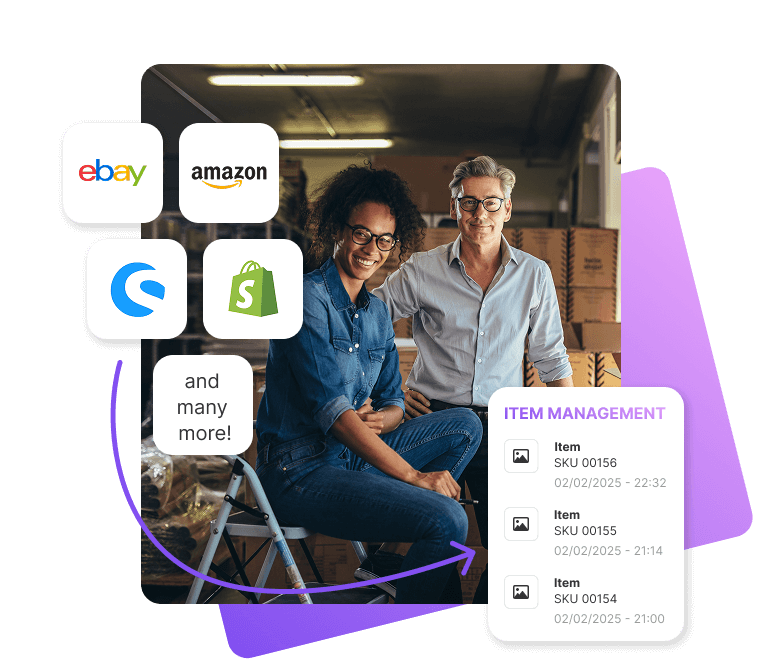

In multichannel eCommerce, inefficiencies often arise due to isolated solutions, a lack of synchronization, manual maintenance and complex warehouse structures. If processes are not properly interlinked, costs and the risk of errors increase, while growth stagnates. With the right multichannel software, systems can be seamlessly connected, processes automated and process costs reduced.
Strong multichannel software bundles all sales channels on a central database, bidsder a powerful merchandise management system, automates daily tasks and connects to stores, marketplaces, warehouse logistics, POS and payment via stable, open system interfaces. It is flexibly scalable, allowing you to integrate new channels and increasing sales order volumes without increasing process costs. JTL’s eCommerce software offers you precisely this combination – optimized for growing multichannel retailers.
Finished interfaces for online stores & marketplaces
and much more.

FAQ on software for eCommerce and multichannel
Multichannel software bundles all sales channels into one system. You only have to maintain items and stock once in a central location, and listings can be sent out with just a few clicks. Sales orders are automatically transferred and processed seamlessly. This saves you time, reduces errors and increases your reach.
Strong multichannel software bundles all channels centrally, automates processes and is scalable across systems. This is exactly what JTL offers – eCommerce software that grows with your business and efficiently connects your processes.
JTL integrates Amazon, eBay, OTTO, Temu & Co. with JTL-Wawi via ready-made interfaces. Product data, stocks and sales orders are synchronized in real time. You control marketplace offers centrally, while all orders are automatically imported and processed via integrated warehouse and shipping processes.
You can find an overview of the available marketplace connections here.
Yes, you can connect store systems such as Shopufy, Shopware and WooCommerce to JTL-Wawi via ready-made connectors. You can integrate other ERP and store systems via the REST API. This allows you to use JTL-Wawi as middleware and a multichannel hub without having to break up your existing system landscape.
In contrast to online store software such as Shopify, JTL focuses on the JTL-Wawi merchandise management system. From there, you control purchasing, sales, warehousing, shipping, accounting and more. JTL combines an online store and a fully-fledged ERP in one system – ideal for multichannel retail with growing sales order volumes.
Yes, JTL-Wawi supports customer-specific prices, discounts and graduated prices, among other things. JTL-Shop offers B2B functions such as customer groups, net price display and individual assortments. You can supplement your setup with specialized B2B extensions for subshops, approval processes or role rights via the JTL Extension Store.
The migration service and import functions in JTL-Wawi help with the switch to JTL. You can transfer item data, categories, customers and orders via CSV or connectors. This allows you to switch to the JTL eCommerce environment step by step without having to manually create new data.
JTL-Wawi offers basic CRM functions such as customer data, notes and order history. The integrated GREYHOUND integration allows you to manage tickets and all communication processes centrally. This allows you to combine automated customer service and order management directly in your eCommerce software.
JTL’s eCommerce software includes ready-made interfaces to DHL, Deutsche Post, DPD, Hermes, GLS, PARCEL.ONE and Austrian Post.