We announced it for the first time at this year’s JTL-Connect: the new production module that we are planning for JTL-Wawi. Although we were expecting it to be very popular, we were delighted with the tremendous response we received from you afterwards. In this blog post, we would therefore like to take the opportunity to provide you with more detailed information about the new feature and introduce you to our plans for the production module.
Do you want to be close to our development right from the start? This project gives you the opportunity to do just that. I will also tell you exactly what this involvement looks like in my article.
Production module - what is it actually?
Many of you do not sell merchandise in your online business, but instead manufacture your own products. Such items are often manufactured to special customer requirements or consist of different components. The refinement or subsequent processing of purchased materials also falls under the generic term “production”.
The parts lists in JTL-Wawi cannot yet be used to fully map the inventory management of various components, the production of items in stock or even a multi-stage production process.
This is set to change with our new production module for JTL-Wawi: With it, it will be possible to manufacture items individually with the ERP after receiving an order – regardless of whether you want to map small or complex production processes. Our production module is designed to help you optimize your production and manufacturing processes and simplify your day-to-day work as a retailer.
What we are planning
As you may have already gathered from our new roadmap, the production module for JTL-Wawi is currently in the “planning & concept phase”.
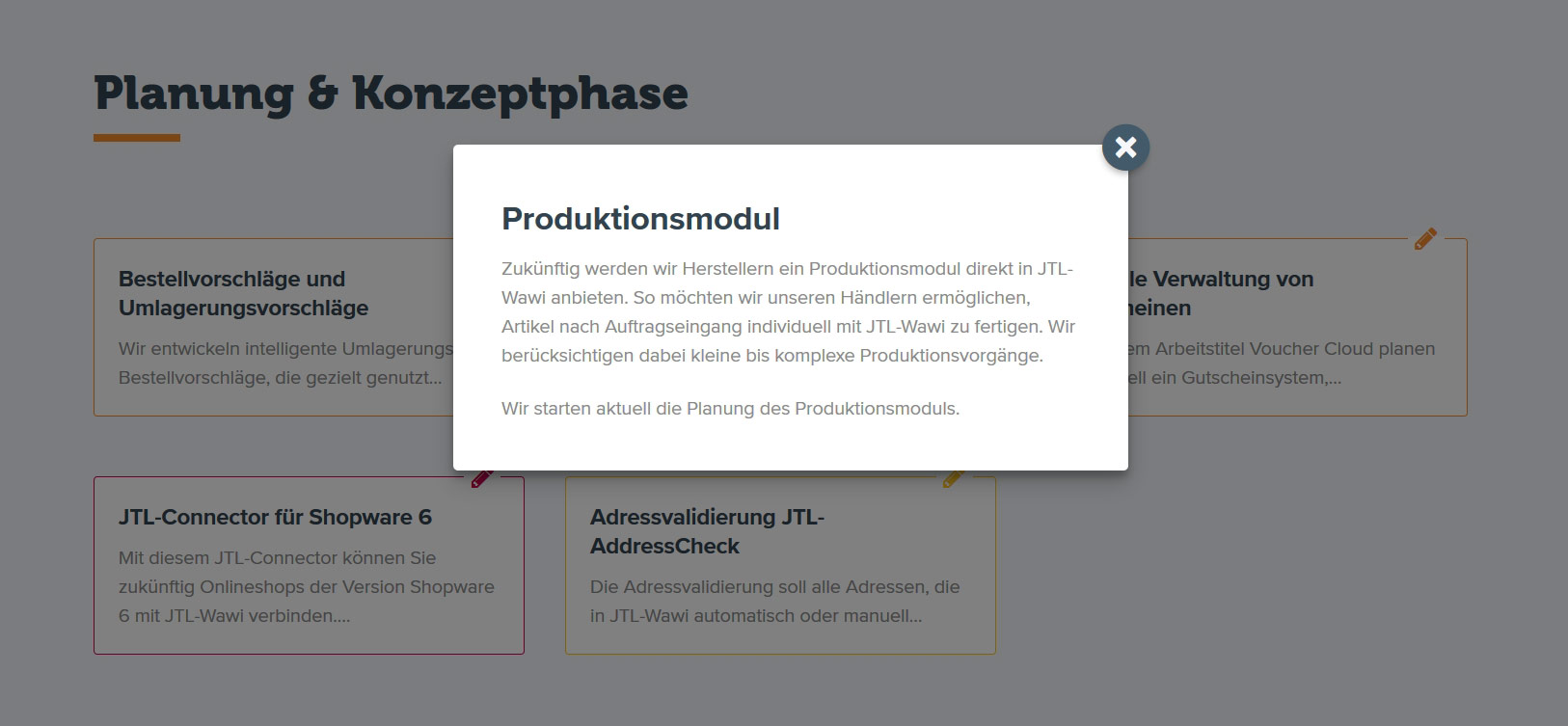
And we have been very busy planning and conceptualizing over the past few weeks. The result is a rough “roadmap” for our development, which we would like to briefly present to you below.
The overarching goal that we are pursuing with the production module is various production processes:
Accordingly, we will develop in several steps:
First, we will look at the production parts lists. Above all, this should make it easier for you to maintain data for assemblies, items and operations. In addition, we will implement simple production and procurement in JTL-Wawi.
After that, we will focus on developing a stand-alone production tool, as you may already know from our warehouse management system JTL-WMS. We plan to closely interlink our production module and JTL-WMS. On the one hand, because both solutions have a lot in common from a technical point of view. On the other hand, we would also like to add production-like cases to JTL-WMS in the long term.
We will pay particular attention to the modularity of our production module: Our goal is that both our service partners and you as customers should be able to individually equip the product with functions. We want to achieve this via a plug-in system. This means that any user with programming skills can develop new, individual functions and integrate them into the production module as a plugin.
Your feedback is needed
We also want to incorporate customer feedback into our development of the production module for JTL-Wawi. In this way, we ensure that we deliver a product that best suits you and your needs. And this time you have a special opportunity to influence and actively shape our development during the planning and concept phase.
Our survey: Take part now!
In order to systematically record and evaluate your wishes and comments, we have created a survey on the production module. In it, we ask for important data and facts that help us to apply the principle of “community-driven development” as effectively as possible.
Take about 20 minutes until Friday, October 25, 2019 to take part in our survey and help us make JTL-Wawi even better with the new production module:
Important note: By participating in our survey on the production module in JTL-Wawi, you agree that your personal data will be stored by us and that we may contact you for the purpose of optimizing our internal development of the feature.