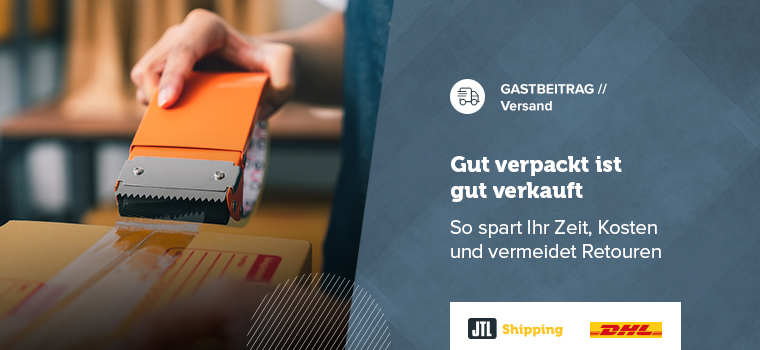
Good packaging means your goods reach your customers faster and undamaged. This ensures a high level of customer satisfaction and saves time and money. We’ll tell you how to pack your goods optimally in three steps.
Why is good packaging so important?
If your customers receive the ordered goods in undamaged and professional packaging, you will not only make a Good first impression. You also reliably protect your goods and provide proof of their integrity at the same time. Secure packaging is also much more sustainable. The carbon footprint of a damaged, repacked and reshipped parcel is immensely higher than packing the parcel securely once – even with more packaging material. Correct packaging therefore pays off several times over.
If a parcel is damaged in transit, there is a risk that transportation will be delayed because the parcel has to be sorted out and made fit for transport again. This is always an “emergency supply” and not necessarily a safe packaging solution. Long delivery times, visible packaging damage and possibly even damage to the goods – these are all reasons that can lead to avoidable returns. Inadequately packaged goods can also lead to further costs in the worst-case scenario: if transport containers, sorting systems or other shipments are damaged, the person who sent the damaged parcel is liable.
So there are many good reasons to pack a parcel securely and professionally:

What does packaging have to do?
Today, parcel networks are highly automated in order to deliver deliveries in the shortest possible time, even with large shipment volumes. During transportation, a parcel can be exposed to very high loads in exceptional cases. When stacking parcels, it is not impossible for heavy parcels to be placed on top of light ones. Impacts from other parcels (each weighing up to 31.5 kg) can also occur. Possible temperature fluctuations are another challenge. Depending on the transport route, a parcel can be exposed to extreme heat or cold for several hours – between -10 and +60 degrees Celsius.
Three steps to perfectly packaged goods
Here are a few professional tips to ensure that your goods reach your customers exactly as you sent them. These three steps will help you to optimally prepare your shipment for dispatch:
Manage shipping material efficiently with JTL-Wawi
With the carton management function in the JTL-Wawi ERP system, you can manage all the data relating to your shipping materials. You no longer have to estimate your requirements, but have an exact overview of how many boxes you actually need. These can be automatically calculated and reordered so that you only ever have to store the quantity you really need. You can also see exactly how much material has been used in which period and per shipment, including size and weight. This is particularly advantageous for the regular reporting obligation under the Packaging Act. In this way, you avoid costs that were previously incurred due to inaccurate quantities. The carton management with all current features is available free of charge in JTL-Wawi since version 1.6.
It's even easier with the right shipping material
DHL business customers can order packaging and shipping materials that meet all requirements directly from the shipping materials store. This online portal has the right outer packaging for every product and every requirement. Those who pay particular attention to sustainability and want to send goods at a reasonable price will find special ECO shipping bags in two different sizes. They are made of flexible yet robust paper from responsible sources and are particularly suitable for textiles and other flexible goods without sharp edges. The fully recyclable shipping bags are popular with customers for many reasons. Not only are they high quality, but they are also easy to open thanks to the practical perforation. Another advantage in terms of sustainability and customer friendliness is that they are easy to reuse in the event of a return. The second integrated adhesive strip makes it very easy to reseal the shipping bags. The ECO shipping bags are space-saving to store and practical to use thanks to their flexible shipping volume.
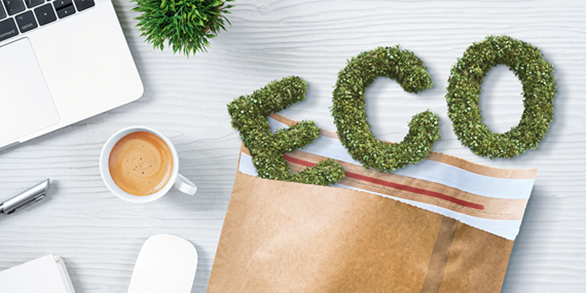
Extra tip: Using a linerless label protects the environment and saves costs at the same time, as the self-adhesive label on the roll does not require a backing material. This means 100 percent more label on the classic label roll with the same diameter. As a result, the roll needs to be changed less frequently and there is no longer any waste product. You can also order the sustainable ECO shipping bags and the linerless label on the DHL online portal.
Would you like to find out more about packaging options? Then you can find more valuable tips at DHL: