In the fifth and final part of our Quick Start Academy, we take a look at the topics of warehousing and shipping from different perspectives. Basically, you have two options: You run a warehouse yourself or you delegate the entire warehouse and logistics processes to professionals. We will show you the advantages and disadvantages of these options and introduce you to software solutions that support you in organizing an efficient shipping process.
The webinars at a glance
Webinar:
Why is professional warehouse management worthwhile?
“Only the stupid need order, the genius masters chaos.” To this well-known quote from Albert Einstein, we say: “You can do it, but you don’t have to.” Because you can only run your own warehouse economically if it is well organized.
Today’s customers have high expectations of online retailers. Educated by their experiences with Amazon, customers assume that an order will be delivered within 24 hours. As a retailer, you need a smoothly running process chain in the warehouse to be able to maintain this time window. There is also the cost factor: the longer your employees search for goods in the warehouse, the more expensive the shipping process will be for you.
In the video recording, we show you how you should consider the factors of time, personnel, effectiveness and efficiency in order to run an economical warehouse:
Webinar:
What characterizes a well-organized warehouse?
Professional organization with intelligent software has a positive effect on all your work processes in stock. We have briefly summarized the most important advantages for you:
Storage options in comparison
If you opt for JTL eCommerce software, you can choose between two types of warehouse: Either you use the standard warehouse in the ERP system JTL-Wawi or you rely on the professional warehouse management system JTL-WMS and set up a JTL-WMS warehouse.
You can ship from the standard warehouse either from JTL-Wawi or more conveniently with the free warehouse solution JTL-Packing Bench+, which we introduced to you on day 3 of our Quick-Start Academy. To operate a JTL-WMS warehouse with multiple storage locations, you need our warehouse management software JTL-WMS. The first user is also free of charge with JTL-WMS, further users are fee-based.
We have compared the differences between the two types of bearings here:
| Standard warehouse with JTL-Packing Bench+ | JTL-WMS warehouse with warehouse management software |
|---|---|
| Only one warehouse, no subdivision into storage bins | Precise determination of the goods location
|
| No optimized routes | Optimized routes
|
| No mobile data collection | Mobile data acquisition
|
| Rudimentary goods receipt | Efficient incoming goods processes
|
| No alternative shipping processes | Four shipping processes to choose from
|
Shipping processes in comparison
You can choose from four different shipping processes in the JTL-WMS warehouse management system. You can also use several of these processes in parallel. Below we have compiled an overview of the most important features of these four shipping processes. You can find more detailed information in the webinar recording.
Simple & scalableThe introduction of JTL-WMS requires some preparatory work. We recommend that you first create a warehouse concept and think carefully about which warehouse structure and which functions make the most sense for your product range.
Once the warehouse has been set up, you benefit from streamlined processes that save you a lot of time and resources. From now on, the warehouse can grow with your business, as new storage locations can be easily added. You can also add additional warehouse processes at any time. Training new employees, such as seasonal workers or temporary staff for Christmas sales, is also easy: JTL-WMS is intuitive and quick to learn. The software is available in German, English and Polish. So you are not limited to the German-speaking world when looking for new staff.
You can watch all the details from the webinar in the video recording. There you will also get a little insight into our warehouse management system JTL-WMS:
To familiarize yourself with JTL-WMS, we recommend the following tools:
Webinar:
How can logistics processes be removed from stock?
Don’t want to run your own warehouse? You can still become an online retailer! With JTL, you have two options for outsourcing your entire logistics and shipping: drop shipping and fulfillment. In this webinar, we explain what these technical terms mean.
What is drop shipping?
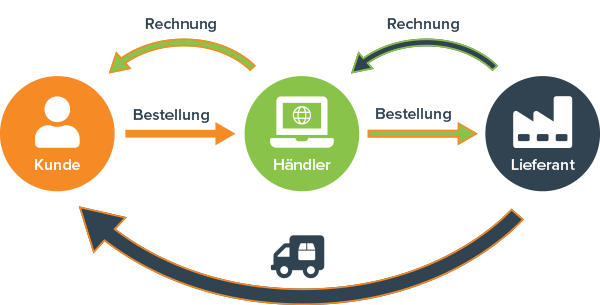
With the drop shipping logistics method, the retailer does not have the goods in stock itself, but instead accesses the goods from one or more suppliers. For example, if a customer orders a T-shirt from the retailer, the retailer places a corresponding sales order with its supplier. The supplier invoices the retailer for the T-shirt. The retailer in turn invoices the customer. The item is shipped directly from the supplier to the customer – without going through the retailer. The item is never the property of the retailer. It is transferred directly from the supplier to the customer.
We have illustrated how the process works here:
Advantages and disadvantages of drop shipping
We have listed the advantages and disadvantages of drop shipping for you here:
| Advantages | Disadvantages |
|---|---|
Low capital requirement
|
Lower margins
|
Fewer teething troubles
|
Inventory transmission/up-to-dateness
|
Lower overheads
|
Supplier error
|
Range width/depth
|
Complexity
|
Location independence
|
You can find out how to get started with drop shipping in practice in our online documentation, the JTL-Guide:
What is fulfillment?
With the fulfillment logistics method, the retailer purchases the goods themselves but stores them with a fulfillment service provider. This fulfillment service provider takes care of the entire shipping and returns process. You can read about the advantages of fulfillment in detail here: Remove from stock – fulfillment listings for retailers.
The best-known fulfillment provider in eCommerce is the marketplace giant Amazon. Many retailers use fulfillment by Amazon (FBA), storing their items directly in Amazon’s warehouses and having them shipped from there.
However, Amazon is by no means the only fulfillment provider. Many logistics companies and freight forwarders offer fulfillment service providers to online retailers. And online retailers who still have free space in their warehouse can also take over shipping for other retailers. To find a suitable fulfillment partner as a retailer, you can use the JTL-Fulfillment Network. More on this below.
Step 1 in the fulfillment process: Storage at the fulfiller
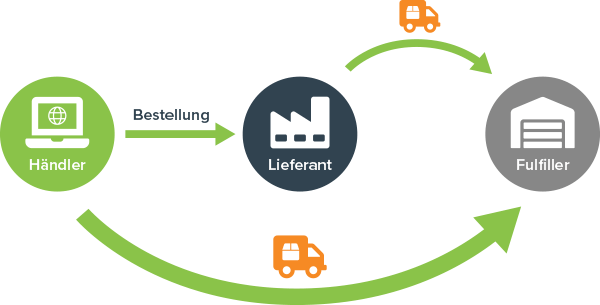
In the first step of the fulfillment process, the retailer purchases goods from its supplier. There are two options here:
- Option 1: The supplier sends the goods directly to the fulfiller.
- Option 2: The retailer first has all goods delivered to its own warehouse and then transfers selected items to the fulfillment provider’s warehouse.
We have illustrated both processes in this graphic:
Step 2 in the fulfillment process: Shipping to the customer
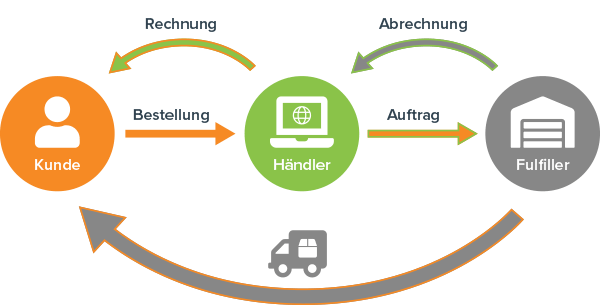
In the second step, we show you how the goods get from the fulfiller to the customer: The customer sends an order to the retailer. The retailer then sends a sales order to the fulfiller. The fulfiller sends the goods to the customer and invoices the retailer for its fulfillment service provider. The retailer in turn invoices the customer for the goods and the shipping costs.
Advantages and disadvantages of fulfilment
We compare the advantages and disadvantages of fulfillment here:
| Advantages | Disadvantages |
|---|---|
Higher margins
|
Higher capital requirements
|
Fewer teething troubles
|
Reduced product range width/depth
|
Lower overheads
|
Complexity
|
Location independence
|
Fulfiller error
|
Inventory transmission/up-to-dateness
|
Possible delivery preparation
|
Watch the webinar recording to get even more information about drop shipping and fulfillment:
Webinar:
How to become an active member of the JTL-Fulfillment Network
After introducing you to what fulfillment is in the last webinar, we are now back to the practical part. In the last webinar on day 5 of the Quick-Start Academy, we will show you how you can use the JTL-Fulfillment Network, JTL’s in-house fulfillment platform, to remove your warehouse and shipping processes from stock to professionals.
What is the JTL-Fulfillment Network?
As a merchant, you can use our online portal for the JTL-Fulfillment Network (JTL-FFN for short) to find a suitable fulfillment service provider for your requirements. As soon as you have found a fulfillment provider and agreed the contract terms with them, you can start working with them with just a few clicks. You simply remove the desired goods from stock from JTL-Wawi and transfer them to your fulfillment provider. From then on, the fulfiller can take care of shipping and returns processing for you.
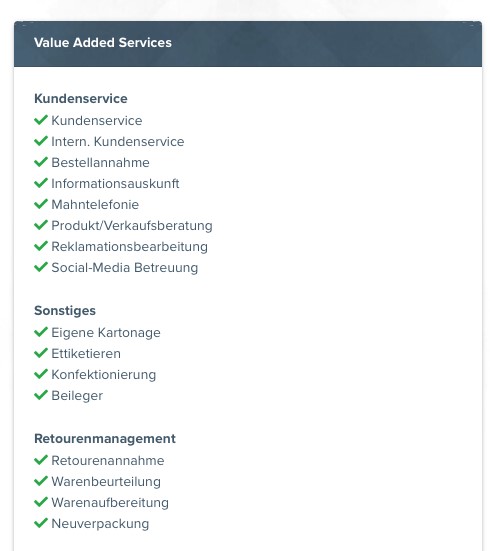
The most important services and advantages of JTL-FFN at a glance:
For all of you who would like to get to know JTL-FFN in more detail, we offer another webinar as additional material. Please note that this webinar already uses more technical language from the areas of eCommerce and logistics.
Participate in the JTL-Fulfillment Network
In the webinar recording, we will show you how to register in the JTL-Fulfillment Network and the JTL-Customer Centre. We also explain how to search for a fulfillment service provider in the portal and which steps are required to start a collaboration. We will also go through the storage of goods at a fulfillment provider and the delivery of sales orders via the JTL FFN in practice. This allows you to follow the central workflows click by click.
FAQWe also ask for these properties when listing the fulfillment service provider. If a warehouse can hold chilled and/or frozen products, you can see this in the exposé under the warehouse types of the corresponding provider.
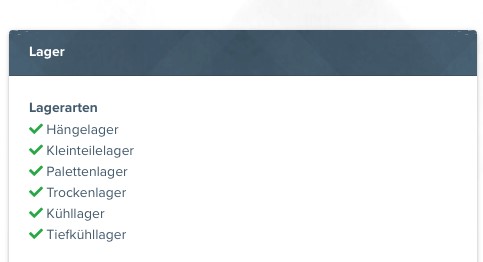
We also ask for these properties when listing the fulfillment service provider. If a warehouse can hold chilled and/or frozen products, you can see this in the exposé under the warehouse types of the corresponding provider.
Just as easily as you have sent your products to the fulfiller for storage using a stock transfer from JTL-Wawi, you can retrieve them again using a stock transfer. The fulfiller will pack your stock transfer order in the same way as a customer order and send it to you. The fulfiller may charge a fee for this service.
JTL is not your contractual partner in this case. We provide you with the platform free of charge. You conclude the contract individually with the fulfillment service provider(s). The notice periods that you agreed upon when concluding the contract apply. After emptying the fulfillment warehouse, you can delete the warehouse in JTL-Wawi.
Take your first steps in the JTL-Fulfillment Network together with us:
To become familiar with the JTL-Fulfillment Network, we recommend the following tools:
With the Quick-Start Academy, we have given you an insight into the whole world of eCommerce with JTL. Now you have the knowledge you need to take your first steps in online business. We wish you a successful start with your new business and look forward to welcoming you back to our webinars soon.
All webinar days of our Quick-Start Academy: