With a complex topic like e-invoices, it’s always best to let those who are real experts in the field have their say. That’s exactly what we want to do in this article. After looking at the legal basis for e-invoicing and the steps involved in switching to e-invoicing in parts 1 and 2 of our blog series, today we’re diving even deeper into the subject. Ulrich Pöhner, CEO at GREYHOUND, has invited his colleague Sascha Lammers, Product Owner E-Invoices, and Johannes Seidel, CEO of JERA, to join him. Good will discuss questions about the regulations that will apply from January 1, 2025 and illustrate which solution is best suited for which retailers.
You can find the full interview, including insights into the software, in the video:
Ulrich Pöhner: What actually is an e-bill?
Johannes Seidel: Most people think that a PDF sent by email is an e-invoice. In fact, the Growth Opportunities Act stipulates that an e-invoice is a digital file that transmits the required invoice content. This can be in XRechnung or ZUGFeRD format.
Ulrich Pöhner: And what is the technology behind it? What exactly happens with an e-bill?
Johannes Seidel: Basically, the same thing happens as with a paper invoice, except that we now have to run this check via procedural documentation. The first step is to check whether the e-invoice received complies with the required standard. Our tools check whether the rules for the structure of the file are adhered to.
Both XRechnung and ZUGFeRD have different formats that are checked differently by the software. Once the check has been completed, a so-called hash is created, which is written into the XML document, i.e. the e-invoice. This hash documents that the invoice has been checked and then not changed.
The first hurdle is therefore to find a tool that can be used to run this technical check. The second step, of course, is to check the content of the invoice. To do this, an XRechnung must first be visualized, i.e. brought into the classic invoice view that we have been used to for years. If it is correct, the invoice is either accepted and paid or a complaint is made. All of these steps must be clearly documented. The invoice is then optionally assigned to an account and forwarded to the accounting department for final filing with the posting record.
Ulrich Pöhner: How can this test be implemented with the DMS from GREYHOUND?
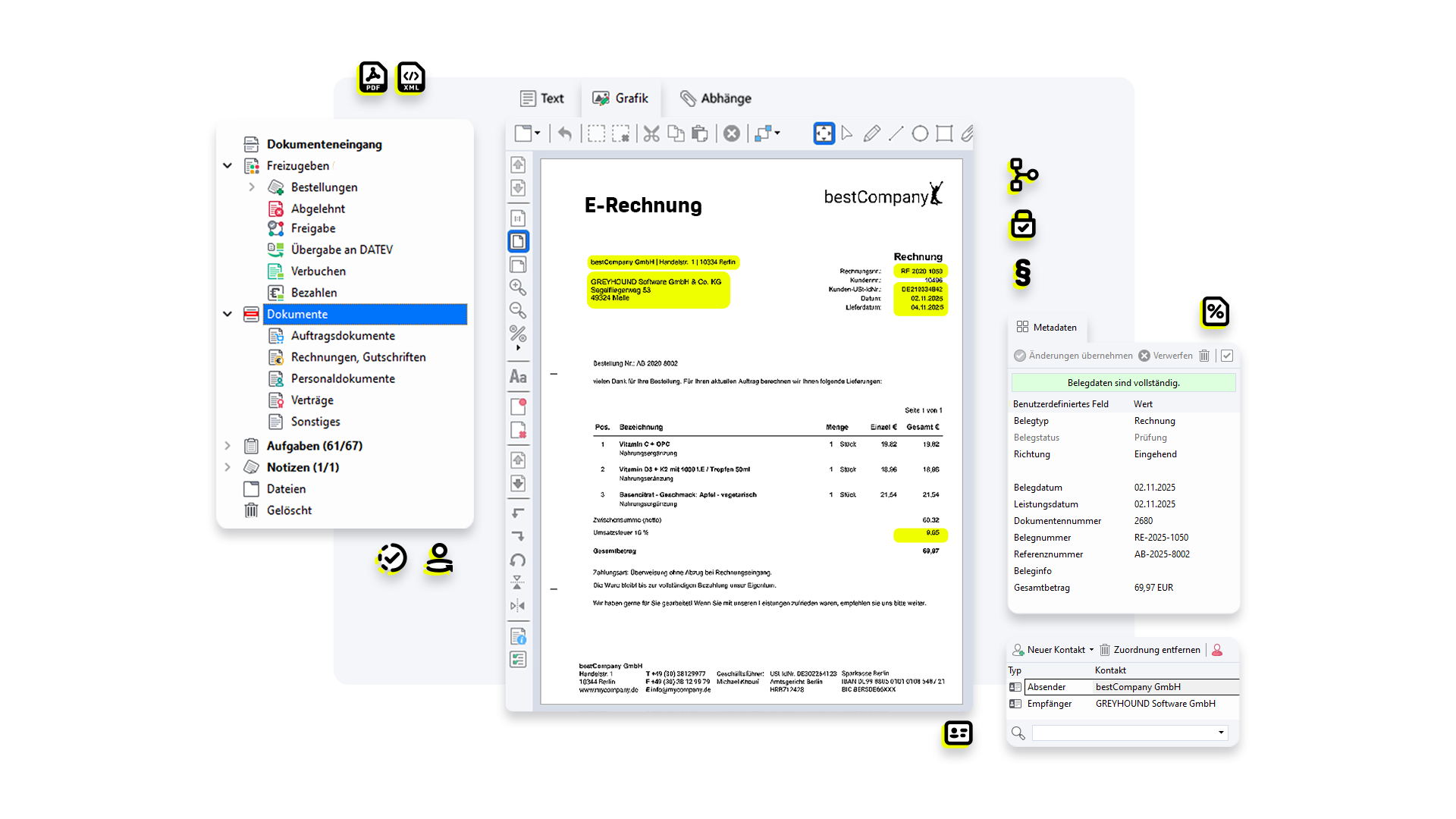
Sascha Lammers: With GREYHOUND, you can display the X and e-invoice in the familiar A4 format, including all details such as VAT, total amount, etc.. It can therefore be checked like a classic invoice. The document data can also be read out in detail.
Ulrich Pöhner: JERA also has a solution for receiving and processing e-invoices, right?
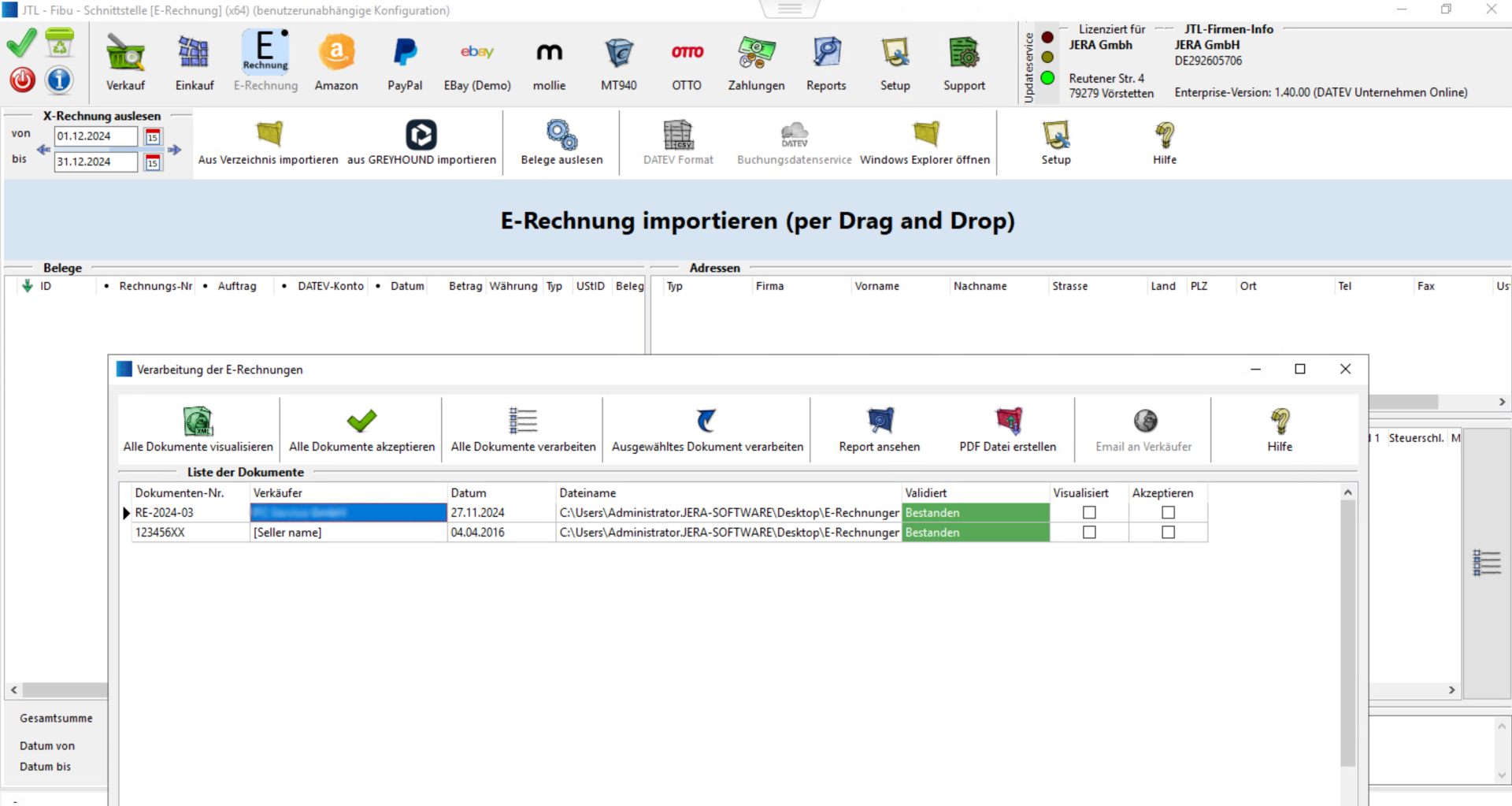
Johannes Seidel: Yes, the solution is called “E-Rechnung 2 FIBU”. It allows us to import, validate, visualize and assign XRechnung invoices as well as ZUGFeRD invoices and forward them to the accounting department.
Ulrich Pöhner: And how do the solutions from JERA and GREYHOUND differ?
Johannes Seidel: The JERA solution is aimed at retailers who have a small range of functions. Our customers are eCommerce companies that have a small administration but a high shipping volume. The volume of A/P invoices is usually manageable and is between 20 and 40 per month. These are usually processed by a single employee, without the invoices having to be checked and run through various approval processes. They are collected at a workstation, inserted into our tool once a month using drag & drop or read from a directory as a batch and transferred to the accounting department. We use accounting software – usually DATEV – for final storage in the audit-proof archive.
Sascha Lammers: With GREYHOUND, on the other hand, large volumes of documents can be processed using practical workflows. The DMS can also directly receive emails with attached X- and e-invoices. Many customers therefore process hundreds of documents a day with GREYHOUND. With our solution, it is possible to define which of these email attachments should be automatically transferred to the document that enters the approval process. Even if an incorrect invoice is received, a corresponding reply can be sent to the sender automatically or manually.
Once automation has been set up for this process of processing e-invoices, it is no problem if thousands of invoices are suddenly received every day. At the end, the invoices are transferred to DATEV – and this is where JERA comes into play.
Ulrich Pöhner: Does that mean there is an interface from GREYHOUND to JERA?
Johannes Seidel: Exactly. We have created a way for our e-invoice 2 FIBU interface to access GREYHOUND via API. We can read out the corresponding documents that have been processed. This data is then transferred from our side back to the DATEV financial accounting system via the booking data service. The special feature here is that we transfer both the XRechnung file and the booking record and link the two together. For example, the tax consultant can call up the linked XML document directly via a link in the booking record and view it again. This saves you having to ask questions afterwards if the experts want to carry out the document audit again. In the event of an audit by the tax office, the document archived at DATEV can be used to directly verify that the work was done properly and that the input tax deduction was lawfully claimed.
Sascha Lammers: “ The approval process is then completed in the final step via GREYHOUND and the invoice is archived in GREYHOUND in a legally compliant manner. It can be retrieved there at any time and fulfills all legal retention requirements.
Ulrich Pöhner: The topic of input tax deduction entitlement is closely linked to the topic of e-invoicing. What options do our customers have to ensure they are well prepared? What would happen if I ignore the topic of e-invoicing from the cut-off date of 01.01.2025?
Johannes Seidel: Then, of course, you are taking a big risk. If I can’t document that the source of my e-invoice corresponds to what I expect, i.e. that the content and technical aspects have been checked, then there is a possibility that an auditor will not recognize this input tax deduction. This can quickly involve large sums of money.
Initially, the topic of e-invoicing is about B2B invoices within Germany, but we are increasingly hearing from industrial companies that they want to receive e-invoices from their suppliers. We therefore assume that the whole topic will spread quickly in the market. After all, the background to this is not only that the tax authorities will have better access to transactions between companies, but also that companies above a certain size will be able to process data automatically. For an industrial company, this means time savings of up to 60% when recording A/P invoices.
Ultimately, that’s what it’s all about: we want to use digitalization to create added value in the form of time savings. And we want to offer tools with which we can optimally support this. JERA for retailers who transport smaller volumes and GREYHOUND for companies that have to process large volumes.
Ulrich Pöhner: Are there any other advantages to switching to e-invoices?
Johannes Seidel: It is no secret that intra-community deliveries and triangular transactions are repeatedly misused for VAT fraud, e.g. through a so-called VAT carousel. In Germany, this results in an annual VAT loss of €50 million. The aim of the e-invoicing obligation is to dry this up. In other European countries, this has been practiced for a long time and VAT fraud has been significantly reduced.
Blog post short & sweet
When it comes to e-invoicing, JERA is the ideal solution for retailers with a small administration without complex approval processes. GREYHOUND, on the other hand, enables companies with a large administrative apparatus to process e-invoices in a particularly time-saving manner thanks to automation. With both solutions, the documents can be transmitted to a financial accounting system such as DATEV and then archived in a legally compliant manner.
All posts in the blog series on mandatory e-invoicing at a glance:
Part 1: Mandatory e-invoicing 2025: Everything online retailers need to know
Part 2: E-invoicing in just a few steps
* The process documentation serves to prove that the requirements of the German Commercial Code (HGB), the German Fiscal Code (AO) and the GoBD for the recording, posting, processing, storage and disposal of data and documents are met when processing digital documents.