
Legal developments and changes are constantly on the agenda in Austria, especially in the area of eCommerce law. Partly initiated by the EU, partly at federal level, Austrian online retailers can also expect new legal rules in 2021. In this guest article, IT-Recht Kanzlei presents the most important upcoming changes and shows how to implement them.
I. The Brexit
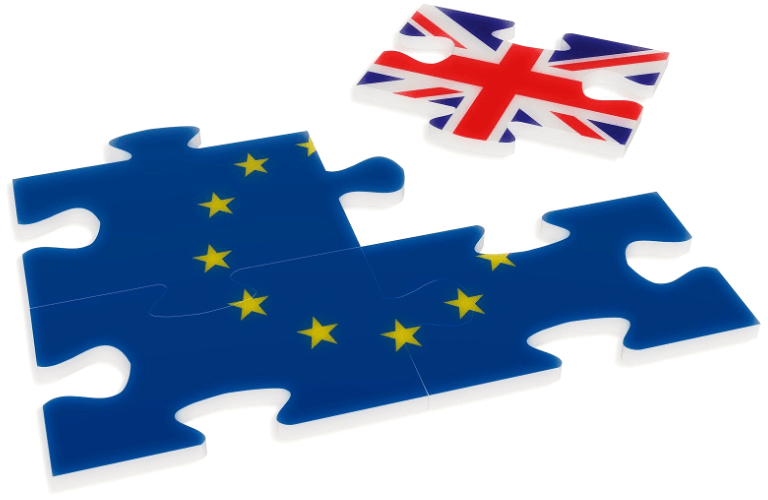
The United Kingdom officially left the EU at the end of 31.12.2020.
Trade relations with the island state now qualify as those with a third country.
Brexit primarily entails changes to VAT law for Austrian retailers when concluding contracts with UK customers.
However, as things stand at present, there will be no significant changes to the implementation of eCommerce legal rights and obligations in transactions with UK consumers for the time being.
Previously, deliveries by mail order to the UK were considered intra-EU deliveries. This meant that Austrian online retailers were generally subject to Austrian VAT as long as the applicable delivery thresholds (previously EUR 82,489 per year for the UK) were not exceeded. VAT was only due in the destination country if the delivery threshold was exceeded.
Since 01.01.2021, the day after the official Brexit, different rules apply. From this date, the UK will no longer be part of the European tax and customs union.
Under VAT law, this means that mail order shipments from Austrian traders to the United Kingdom are deemed to be so-called “tax-free export deliveries”.
VAT is payable in the UK alone – from the first penny.
In principle, Austrian mail order companies must therefore register for VAT in the United Kingdom for the export of goods from 01.01.2021 (existing registrations remain valid).
However, there is an exception for sales on online marketplaces. If goods are sold directly to the UK via a marketplace such as eBay or Amazon, the marketplace must handle the VAT clearance for the retailer.
Note on value limits for import sales tax and customs duties:From 01.01.2021, import VAT and customs duty exemption will no longer apply to deliveries worth less than GBP 15. The value limit of GBP 135 will be decisive.
Beyond the new tax regulations, not much will change for Austrian online retailers selling goods to British consumers for the time being.
This is because in the comprehensive partnership agreement between the EU and the UK, the UK has recognized the far-reaching continued validity of EU consumer law and is thus retaining provisions that have already been transposed into national law for the time being.
This concerns online consumer contract law, including the right of withdrawal and the General Data Protection Regulation.
However, consumers in the UK will no longer be able to invoke the EU Regulation on Online Dispute Resolution from 2021.
Nevertheless, it is still too early to tell what impact the new partnership agreement will have in detail on the rules for cross-border online trade between the EU and the UK. Many issues will continue to be negotiated in countless working groups.
II. New energy labels for household appliances
In 2021, the EU requirements for the energy consumption labeling of household appliances will be amended and the current efficiency labels will be replaced.
The main aim of the change is consumer protection, as the regulations are intended to ensure greater transparency. Technical progress and the resulting changes in the energy properties of some product classes also make this step necessary. The new labels now only contain the efficiency classes A-G and no longer – as before – “plus classes” such as “A+++”.
For many energy-related products, this results in new labeling measures for Austrian online retailers, which must be fulfilled using the amended labels.
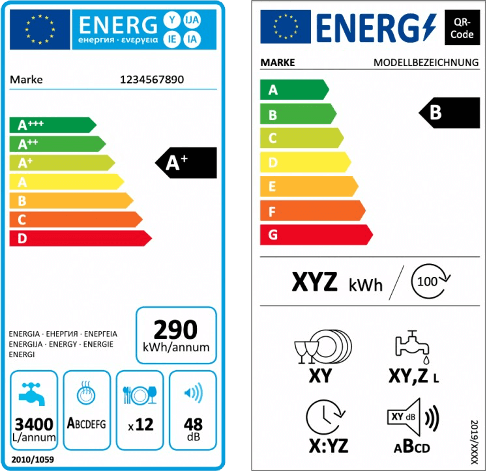
The new efficiency labels have a standardized efficiency spectrum from A-G and are mandatory for the following appliance classes:
- Dishwasher according to Regulation (EU) 2019/2017
- Washing machines and tumble dryers in accordance with Regulation (EU) 2019/2014
- Refrigerators and wine coolers in accordance with Regulation (EU) 2019/2016
- Light sources in accordance with Regulation (EU) 2019/2015
The following product classes will also be regulated for the first time with energy consumption criteria and the associated labeling obligations and new labels:
- Electronic displays (previously only televisions, but now also monitors etc.) in accordance with Regulation (EU) 2019/2013
- Commercial refrigeration appliances with a direct sales function (e.g. in supermarkets) in accordance with Regulation (EU) 2019/2018
The new efficiency labels will apply to the following appliance types from 01.03.2021:
- electronic displays
- Commercial refrigeration appliances with direct sales function
- Household dishwasher
- Domestic refrigerators
- Domestic washing machines and dryers
The new labels will only apply to light sources from 01.09.2021.
Retailers who offer energy-related appliances have to comply with legal deadlines within which they must incorporate the new labels and the amended efficiency classes and efficiency spectra in online listings and online advertising.
The deadlines that retailers must observe for the presentation of the new labels are set out in Art. 11 (13) of Regulation (EU) 2017/1369.
a) Obtaining the new labels
First of all, retailers must be provided with the new labels by the suppliers (manufacturers or importers), both in physical and electronic form.
This must be done within a period of 4 months from the respective start date (i.e. from 01.11.2020 or from 01.05.2020 for light sources).
If retailers do not receive the new labels from the supplier on their own initiative, they must make them available at the request of the retailers.
b) Deadlines for the presentation of the new labels
Retailers must exchange the new labels for the old ones within 14 days of the respective changeover date (01.03.2021 or 01.09.2021 for light sources).
The replacement obligation applies both in stores and online.
This means:
By 15.03.2021 or, in the case of light sources, by 15.09.2021, retailers must
- replace the electronically stored labels in all online sales offers with the new ones (more information on the electronic labeling obligation for products here)
- Replace the printed labels on all physically issued devices with the new ones
c) What applies to pure advertising?
The energy efficiency labels are only to be displayed in listings, i.e. those in which the consumer is informed of all relevant product features and the price in such a way that he could easily conclude the transaction.
On the Internet, product detail pages generally fulfill the offer character.
According to current law, only the following information must be presented in advertising for energy-related products:
- the efficiency class of the product
- the scale of efficiency classes according to the label
Retailers must also amend the efficiency labeling in advertising within 14 days of the changeover date (i.e. by 15.03.2021 at the latest or 15.09.2020 for light sources) and adapt it to the new efficiency framework.
The display of the new labels (or the display of the scale values in advertising) is only permitted online and offline from the respective changeover date (01.03.2021 or 01.09.2021 for light sources).
Before this date, retailers are prohibited from displaying the new labels.
III. Abolition of the tax-free limit for imports of goods from third countries and necessary electronic advance declarations
A large number of Austrian online retailers offer products from the Far East at low prices, which are then delivered directly to the customer by Asian suppliers. The success of this business model is based not least on tax benefits for drop shipping retailers and mail order companies from third countries: There is no import sales tax up to a goods value of 22 euros. Due to numerous complaints from European retailers, this will change significantly on 01.07.2021.

Drop shipping models have so far been highly lucrative for European retailers. In cooperation with suppliers, mostly from the Far East, they can offer products at the lowest prices and have them sent directly to the customer from Asia.
Up to now, such traders have also enjoyed a double tax advantage:
The delivery from the Far East is tax-free for the supplier as an export delivery; foreign VAT may not be shown on the invoice to the German retailer. The delivery to the customer within Germany is attributed to the retailer as an “unmoved delivery” and is taxable under VAT law. German VAT is therefore incurred, but this is payable by the customer and is only to be paid by the retailer.
So far, drop shipping retailers have also been given preferential treatment with regard to import sales tax (EU VAT). This is always incurred for import deliveries from third countries and is generally borne by the German drop shipping retailer in the case of “duty unpaid and untaxed” delivery conditions. However, there is an exemption limit: up to a goods value of 22 euros, import VAT is not payable.
A large number of drop shipping products do not reach this value of goods, allowing drop shipping retailers to offer listings at particularly favorable prices without tax and accounting burdens.
This exemption limit for import VAT will be completely abolished as of 01.07.2021. The reason for this is a decision by the Economic and Financial Affairs Council of the European Union (ECOFIN). From 01.07.2021, import VAT will therefore be levied from the first cent.
The abolition of the exemption limit will be accompanied by a further obligation: an electronic customs declaration with tax collection will be required for all consignments of goods from third countries to the EU – regardless of the value of the goods. The legal basis for this is Delegated Regulation (EU) 2019/1143, which is intended to ensure seamless customs and tax registration and prevent tax fraud, particularly in the small consignment sector.
In the small consignment sector with goods worth less than EUR 150, for which no customs duty but import VAT is payable, electronic recording is to be ensured by means of a simplified procedure with reduced data records.
IV. Changes to sales taxation in the EU mail order business from 01.07.2021

From 01.07.2021, there will also be changes to VAT law in intra-community distance selling, i.e. in contracts for the supply of goods from the territory of one member state to that of another member state.
This affects deliveries to private customers or business customers without a VAT identification number (UID number).
Until now, VAT liability obligations have been based on a delivery threshold principle. An Austrian trader is generally liable for VAT on intra-community deliveries in Austria, unless he exceeds the VAT-based delivery threshold set by another Member State. If this delivery threshold is exceeded, sales in the destination country of the delivery become subject to VAT.
This delivery threshold differentiation is now to be abolished as of 01.07. 2021. From now on, the VAT rate of the country of destination will apply to mail order deliveries to consumers and entrepreneurs without a VAT number.
There will only be an exception for micro-entrepreneurs with turnover of up to EUR 10,000. These will continue to be taxed solely in the country of origin.
IV. New EU consumer law through the so-called "Omnibus" Directive
Directive (EU) 2019/2161 of 7 January 2020 amends four existing European directives (therefore also known as the “Omnibus” Directive) in the areas of consumer protection and competition law.
The Austrian legislator must transpose the requirements of the directive into national law by 28.11.2021 at the latest. The new requirements must be applied in Austria from 28.05.2022 at the latest.
The new directive reforms large parts of European eCommerce law, which will bring major changes for Austrian online retailers.

In the following, we would like to give you a brief overview of the main changes that the “Omnibus” Directive will bring for Austrian online retailers.
a) Extension of the scope of the Consumer Rights Directive
The Consumer Rights Directive, which has already been transposed into Austrian law since 2014, will in future also apply to contracts for digital content that is not stored on a data medium and for digital services if the consumer provides the trader with personal data for this purpose and the trader does not need and process this data solely for legal requirements under this Directive (payment with data and not by payment).
In the future, questions of demarcation between digital content and digital services will also arise here.
b) Changes to the consumer withdrawal policy
There are changes to the details of the mandatory notification of consumers about their statutory right of withdrawal, in particular with regard to the marketing of digital content that is not stored on a data medium.
As is always the case with revocation instructions, retailers will have to reproduce the changes exactly, as otherwise there is a risk that the revocation instructions will be vulnerable to attack.
c) Omission of the obligation to state the fax number in consumer withdrawal instructions and the withdrawal form
In future, it will no longer be mandatory to state an existing fax number in the withdrawal instructions and the model withdrawal form, as the EU Commission considers fax technology to be obsolete nowadays.
d) Extended contact information for distance contracts
There will also be changes for traders in future with regard to the mandatory contact information for distance selling contracts. The scope of mandatory information will be expanded on the retailer side.
e) Obligation to provide information if personalized price is calculated on the basis of automated decision-making
A new information obligation exists for retailers if the price displayed to the consumer has been personalized on the basis of automated decision-making or the creation of consumer behavior profiles.
f) Strict regulations for price reductions
The directive also leads to massive changes in price indication law.
In future, each time a price reduction is announced, the previous price applied by the trader over a certain period of time prior to the price reduction must be stated. The previous price is the lowest price applied by the retailer within a period of at least 30 days prior to the application of the price reduction.
g) Duty to provide information on customer reviews
When using product reviews, online retailers must in future provide information on whether and how they ensure that the published reviews originate from consumers who have actually used or purchased the products. This is intended to prevent abusive customer reviews.
h) Inadmissibility of the sale of goods of different quality as identical
In future, a retailer will be committing an unlawful misleading act if they actually market different products as identical products in the EU. This means that if there is an “economy version” of a product for a particular EU market, it may no longer be listed as identical to the version for the other EU markets.
n addition to the substantive legal changes in eCommerce, the Omnibus Directive also drastically tightens the law on sanctions for violations of consumer rights:
For the first time, the imposition of substantial fines in accordance with an EU-wide harmonized catalog of fines will be provided for by law.
In order to ensure that the fines also have a deterrent effect, Member States should set a maximum amount of fines for cross-border infringements of consumer protection law of at least 4% of the trader’s annual turnover in the Member State(s) concerned.
If no information on annual turnover is available to the authorities, the maximum amount of a fine should still be at least EUR 2 million.
If consumers are harmed by unfair commercial practices, the same liability regime will apply. In addition, consumers will then have their own legal protection options, such as the right to withdraw from the contract.
V. Innovations for trade in digital content and services
Another change that will affect Austrian online retailers in 2021 is the implementation of Directive (EU) 2019/770 on certain aspects of contract law relating to the supply of digital content and digital services.
This directive includes some changes for the trade in software, apps or e-books.
Accordingly, only online retailers who offer corresponding content and/or services are affected.
The EU directive must be transposed into national law by 01.07.2021 and should apply from 01.01.2022.

a) Obligation to update
In future, online retailers will be obliged to provide function-preserving updates and security updates when selling digital products.
In the case of ongoing contractual relationships, this obligation should apply for the entire duration of the contract. In the case of one-off contracts, such as sales contracts, it should apply for a period that the consumer can reasonably expect.
b) Liability for defects
For the first time, the new provisions provide for explicit warranty rights for digital products.
In future, a digital product will be free of product defects if it meets the subjective requirements, the objective requirements and the integration requirements at the relevant time in accordance with the new regulations.
Consumers are to be entitled to the following rights for digital products in future:
- Subsequent performance
- Termination of contract
- Compensation for damages
- Reimbursement of expenses
- Reduction
c) Reversal of the burden of proof
In future, there will be a legal presumption of the existence of a defect in a digital product if a defect in the digital product becomes apparent within a certain period of time.
The planned legislative changes will have a massive impact on Austrian online retail.
This applies in any case to retailers who offer exclusively or also digital content and/or digital services.
What was previously only rudimentarily regulated by law in Austria may in future be regulated in just as much detail as the law on contracts for the sale of goods or the law on work and services.
Once the new regulations come into force, affected retailers will have to take them into account when concluding contracts with consumers. If the retailer uses general terms and conditions, these would have to be adapted to the new regulations in future. Contractual provisions in general terms and conditions that deviate from the planned regulations to the detriment of the consumer could be objected to as inadmissible in future.
However, as the directive must also be implemented in the other EU member states, there will be largely harmonized regulations within the EU in the area of trade with digital products and digital services in the future. As a positive side effect, this should at least lead to greater legal certainty for Austrian online traders when concluding contracts with consumers from other EU member states.