
Part 4 of the blog series: SEO for online stores
ChatGPT, DeepL and Neuroflash are currently on everyone’s lips and show that artificial intelligence, or AI for short, has long since made its triumphant entry into our everyday (working) lives. Critically eyed by many, acclaimed by others, the new tools offer many exciting applications that can speed up processes and uncover gaps in knowledge – including when it comes to SEO.
In the last part of our four-part SEO for online stores blog series, we look at how artificial intelligence can help you to tackle and complete important SEO tasks to improve the visibility of your online store. If you haven’t already done so, we recommend reading the first three articles in this series. There you will learn about the importance of a good information architecture in your online store, how to create search engine-friendly content and which aspects of technical SEO you should tackle in order to optimize your online store for search engines.
So how can AI be used to make your online store more SEO-friendly, and where do the tools reach their limits? Let’s take a closer look!
In which areas you can use AI for SEO in your online store
When we talk about artificial intelligence, we mean the ability of computers to perform tasks that previously required human intelligence. In terms of SEO, this includes, for example, the analysis of large amounts of data, the identification of trends, the creation of (high-quality) content and keyword optimization.
Even though many well-known SEO tools have already helped with some of these tasks, there is now a subtle difference: previous analysis tools tended to function as one- or few-dimensional measuring instruments in existing data sets. Artificial intelligence, on the other hand, combines many different dimensions, creates something new and thus functions like a virtual idea generator. Numerous SEO tools are currently expanding their listings to include the possibilities of artificial intelligence, so that the transitions in handling are often fluid and you have access to extended functionalities that you can use to your advantage. If you use a fee-based version of ChatGPT, there are also various specialized AI SEO tools available that are worth a look. We would like to highlight three areas of application in particular at this point.

Optimization of title tag and meta description
Good metadata such as the title and meta description are among the most important factors in search engine optimization. Artificial intelligence can not only help you to generate meta tags that meet the usual SEO standards, but you can also adapt them specifically to your product range and individual needs. This can be, for example, the addition of a call-to-action, an emotional appeal or certain keywords that should appear in the text of a meta description. To do this, you need to formulate a precise prompt that tells the bot what you want from the text. It is particularly efficient if you have your unique and relevant meta information created for all products and categories at the same time. This saves you an enormous amount of time, especially with large product catalogs.
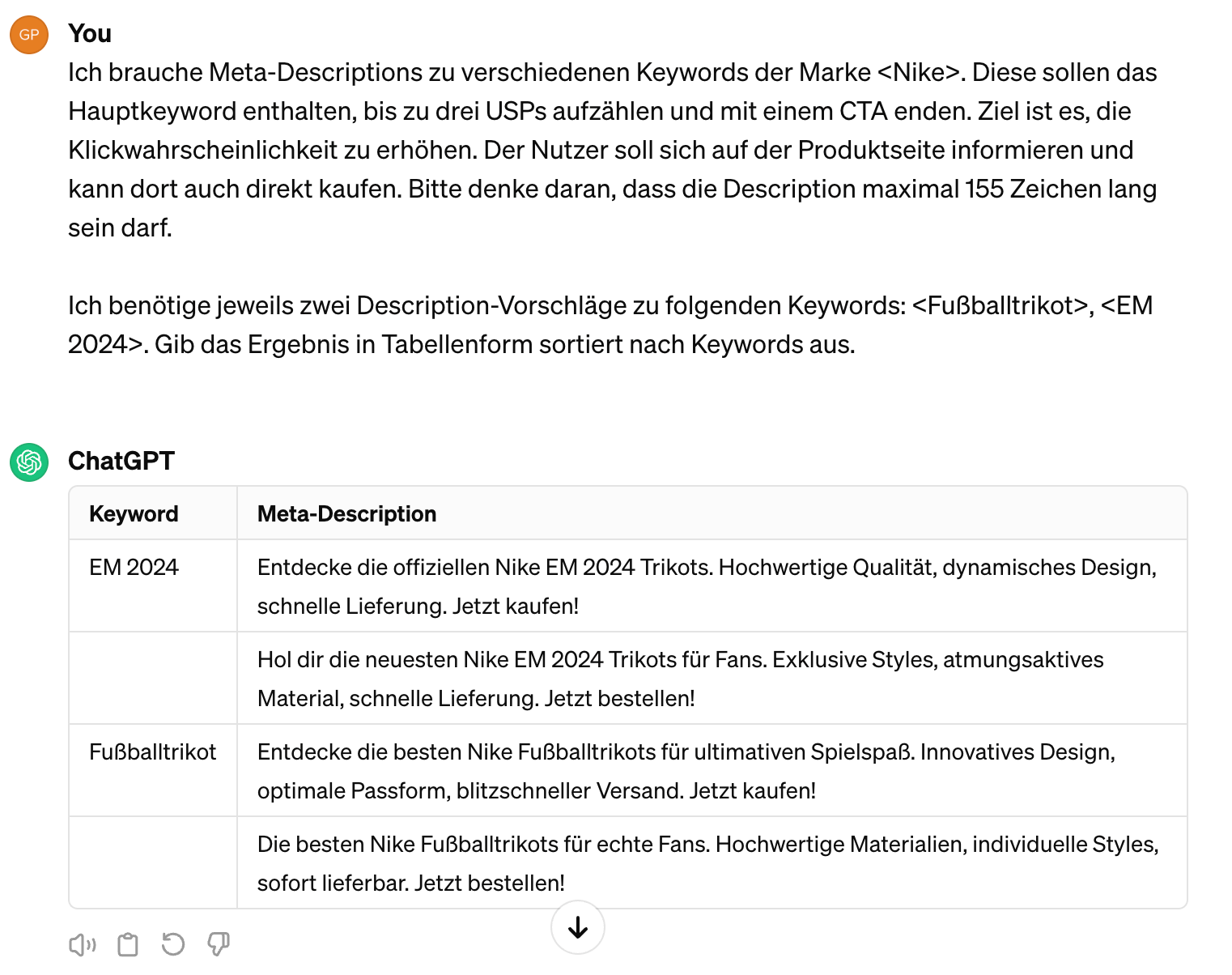
Some AI tools are also able to automatically analyze the status of your online store with regard to missing or improvable information and suggest corresponding optimizations to titles, descriptions or even images to help boost the visibility of your store in the search results.
Keyword research, clustering and optimization
How many hours have you already spent in front of your screen researching relevant keywords, clustering them and regularly checking and updating the list? AI can help you to largely automate these processes. The tools use technologies such as Natural Language Processing (NLP) to analyze user search behavior and suggest semantically relevant keywords and phrases that can potentially increase traffic and conversions in your online store. At the same time, keyword clusters can be generated that group keywords thematically based on search intent.
AI tools are also able to detect trending topics and developments and regularly check and update the keyword sets relevant to your domain. This saves time and, with patience, ideally ensures wider visibility and sustainably better results in the search engines.
Content creation and optimization
This area is certainly the most popular application for artificial intelligence at the moment. The automated generation of many different types of text, from product descriptions and FAQs to category texts or blog posts, significantly shortens writing processes. It is also possible to train AI tools with your own texts so that the system can imitate your individual writing style and generate new texts in your style.
But even if you prefer to write your texts yourself and add a personal touch, you can use artificial intelligence for content ideas and impulses that you may not even have thought of yourself.
The listing of AI tools for SEO is large and growing every day. It is therefore worth keeping up to date and trying out free versions to play with their possibilities. You can find out which AI tools have already been tested, how they perform and how much they cost in this comparison by OMR.

What limits AI sets for you in terms of SEO
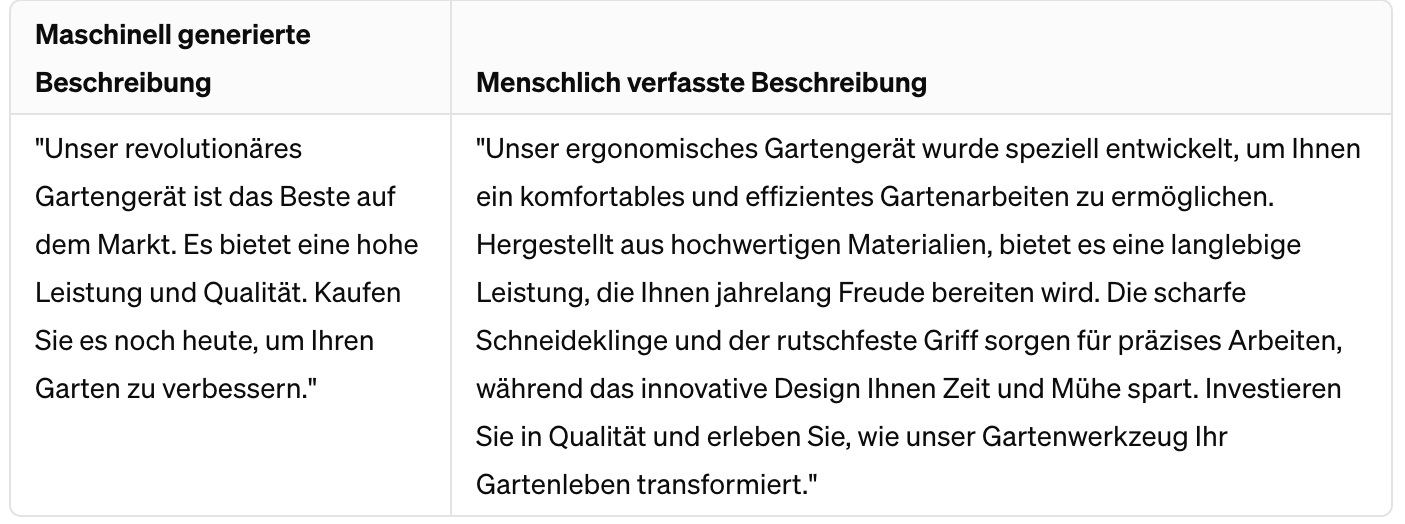
As exciting as artificial intelligence may currently be, it (still) has its limits. On the one hand, this concerns the quality of the generated content, which is often less creative and personal than texts written by humans. The quality and originality of the content can therefore fluctuate greatly and usually requires post-processing. Given the importance of creating unique content, this is the better idea anyway.
Good news for anyone who enjoys writing texts: The depth of content and the illustration of facts based on human experience as well as the ability to tell an exciting story about a product will remain in human hands for quite some time.
Secondly, integrating AI tools into existing SEO workflows can be difficult as it requires specific expertise and changes workflows. Adding these tools to existing systems and processes can require technical adjustments and training, which can be time-consuming and costly.
You should also think carefully about which AI tools you use to achieve the desired results. Even though some tools can increase your efficiency, you should make sure that they meet the specific requirements of your SEO workflow and only use tools that offer you real added value.
Exciting developments that still need time
AI enthusiasts are excited about the new possibilities and the efficiency gains through automation and process acceleration. But the new helpful tools should not be the sole basis for your search engine optimization efforts. Human expertise and an understanding of the specific needs of your target groups are still crucial for the success of your online store. In addition, the new tools are not exactly cheap, even if you can already do a lot with the basic or trial versions listed to gather initial ideas and save time on tedious tasks.
However, it is always advisable to regularly take a look at current AI developments. Just like reading our previous articles in the “SEO for online stores” series. Thank you for your attention over the past few weeks. We wish you Good Business and hope that one or two tips will possibly contribute to this.
All posts in the SEO blog series at a glance:
Part 1: Information architecture in the online store
Part 2: Content – preparing content optimally
Part 3: Technical SEO to improve performance
Part 4: Artificial intelligence – SEO application areas