Introduction of a warehouse management system (WMS)
Rising order numbers, growing product ranges and more complex supply chains pose major challenges for many companies. When inventories become confusing, employees are overworked and errors increase, customer satisfaction suffers – and with it, business success.
A warehouse management system (WMS) offers the solution: it digitizes, automates and optimizes all warehouse processes. From goods receipt to dispatch, it ensures transparency, efficiency and control. This guide explains what a WMS can do, when it is worth introducing it and how it can be successfully integrated into existing structures.
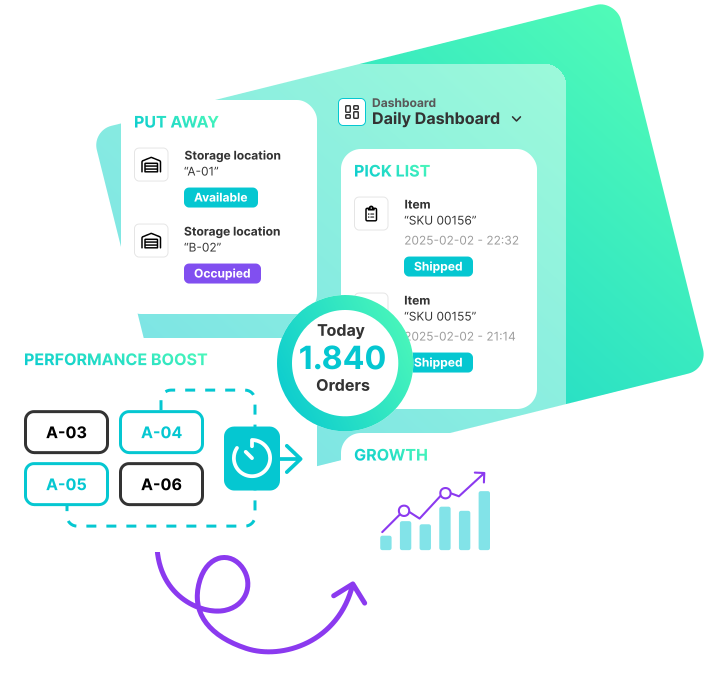
A warehouse management system (WMS) is specialized software that digitally maps and controls all warehouse processes. It enables companies to track stocks in real time, process sales orders efficiently and automate workflows.
A WMS records all goods movements using bar codes, RFID systems or sensors. Intelligent algorithms calculate optimal picking routes, while real-time data helps to avoid bottlenecks or shortages.
With the help of a modern warehouse management system, this speeds up processes, reduces costs and eliminates sources of error.
A WMS thus forms the central nervous system of warehouse logistics – it connects people, technology and data in a smoothly functioning overall system.
Both systems are used to organize warehouse processes, but differ in terms of depth and range of functions. Warehouse management software focuses on the management of storage locations and stocks. It enables clear recording of items, goods receipts and goods issues – ideal for smaller warehouses with manageable processes.
A warehouse management system goes far beyond this. It integrates additional functions such as order preparation, packaging, shipping control and integration with ERP systems or online stores.
A WMS also enables automation, for example through pick-by-light systems, conveyor technology or robot solutions.
In short:
- Warehouse management software manages stocks.
- WMS controls complete logistics processes – in real time, automated and networked.
For growing companies or complex logistics structures, a WMS is therefore the more economical solution in the long term.
The ideal time depends on several factors. In practice, however, it is clear that the earlier processes are digitized, the more sustainable the success. A WMS becomes particularly important when:
- stocks are difficult to keep track of and differences are increasing,
- Picking errors and delivery delays cause costs,
- seasonal fluctuations overload capacities,
- or several storage locations have to be managed.
Many companies hesitate with the introduction until problems become acute – but then the effort is greater. Those who rely on a WMS at an early stage benefit from clear processes, lower error rates and a solid basis for further growth.
A system introduced in good time ensures that processes remain stable and efficient even when demand increases and seasonal peaks occur.
Advantages of a warehouse management system for companies
A WMS revolutionizes warehousing through transparency, automation and integration. It combines physical processes with digital control mechanisms – and thus ensures efficiency in real time.
The key benefits include optimized processes, scalability, precise data management and improved service quality.
Optimized processes: Order preparation, packaging and storage space utilization
A WMS analyzes all movements in the warehouse and calculates optimal routes. It automatically assigns picking orders and integrates into automated storage and retrieval systems (AS/RS).
Precise control and clear instructions – for example on packaging size or filling material – speed up work processes and reduce errors.
Advantages:
- Faster order processing thanks to automated picking and packing processes
- Fewer picking errors thanks to bar code and RFID technology
- Good use of space thanks to intelligent storage space allocation
This process optimization has a direct impact on customer satisfaction and delivery times.
Scalability and flexibility
Modern WMS solutions have a modular structure and grow with the company. Cloud-based systems make it possible to integrate new warehouse locations, article groups or sales channels with little effort.
Advantages:
- Flexible adaptation to seasonal fluctuations and growth
- Reduced IT costs through cloud hosting
- Scalable infrastructure without system downtimes
This means that the warehouse remains efficient and clear, even with strong growth.
Real time data management
A major advantage of a WMS is the availability of real-time data. All movements in the warehouse – from goods receipt to order preparation and dispatch – are recorded and evaluated in fractions of a second.
Advantages:
- Up-to-date inventory data and transparent stock movements
- Early detection of bottlenecks and excess stock
- Improved decision-making basis for purchasing and scheduling
All data is synchronized via IoT sensors and interfaces to the ERP system so that delivery times can be calculated precisely and processes can be controlled with foresight.
Practical advantages in everyday store life
A WMS shows its strengths in practice – regardless of industry or company size. Three typical application examples illustrate the range:
- Electronics retail: bestsellers such as smartphones and accessories are automatically placed close together. This reduces walking distances and speeds up order preparation – even during peak periods such as Christmas sales.
- Fashion industry: WMS recognizes seasonal trends and prioritizes items in demand such as winter jackets or sneakers. Shortages are reported automatically and reorders are triggered in good time.
- Food retail: best-before dates are monitored so that older goods are delivered first. This reduces waste and improves product quality.
These examples show: A WMS creates measurable efficiency gains – from the product range to order preparation and customer satisfaction.
Introduction and implementation of a warehouse management system
The introduction of a WMS is a strategic project that requires careful planning. However, with a clear structure and good preparation, the process can run smoothly.
Introducing a WMS means analysing existing processes, digitizing them and adapting them step by step to new processes.
How do you proceed?
The implementation process can be divided into three central phases:
- Analysis and planning:
Existing processes are recorded, requirements defined and potential identified. All warehouse areas – incoming goods, order preparation, shipping – should be taken into account. - Employee training and involvement:
The success of a WMS depends on user acceptance. Employees should be involved at an early stage and receive targeted training. This reduces the changeover time and new processes are internalized more quickly. - Technical integration:
The WMS is integrated into the existing IT infrastructure. Interfaces to ERP systems, scanners or conveyor technology ensure a smooth data exchange.
A gradual introduction – initially in individual warehouse areas, for example – has proven to be particularly efficient.
Possible challenges when introducing a WMS
Even with Good preparation, stumbling blocks can occur. Typical challenges are
- Adaptation to existing hardware (e.g. scanners, conveyor systems)
- Employee resistance to new systems
- Initial uncertainties when using the software
These can be minimized through clear communication, targeted training and a step-by-step rollout concept. An experienced implementation partner can also identify and eliminate technical hurdles at an early stage.
Integration of a WMS into other areas of the company
A WMS only unfolds its full benefits when it is networked with other company systems. Integration with the ERP system, which coordinates central business processes such as purchasing, accounting and shipping, is particularly important.
By synchronizing the WMS and ERP, all data – such as stock levels, sales order status or stock movements – is available in real time. This transparency ensures that other departments can also work more efficiently and with greater foresight.
The following shows how purchasing, sales and customer service in particular benefit from an integrated WMS:
Purchasing – recognizing requirements, planning replenishment
Purchasing benefits from the WMS thanks to precise and up-to-date stock data. The system recognizes early on when certain items are running low or seasonal demand is increasing and can automatically generate reordering suggestions.
Advantages for purchasing:
- Demand-based replenishment:
The WMS automatically logs in stock levels below defined thresholds to the ERP, triggering reorders in good time. - Supplier management:
Precise consumption data enables the purchasing department to optimize order cycles, compare delivery times and negotiate more favourable conditions. - Avoidance of excess stock:
Accurate forecasts prevent unnecessarily tied-up capital and storage costs.
An integrated WMS therefore provides purchasing with the basis for strategic procurement instead of reactive reordering.
Sales – transparency and planning security
Sales also benefit directly from the warehouse data synchronized in real time. Sales staff can provide customers with reliable information about stock availability, delivery times and order status at any time. This creates trust and makes sales planning easier.
Advantages for sales:
- Real time stock availability:
The sales department can see immediately which items are in stock and in what quantities – even if there are several locations. - Binding delivery commitments:
Up-to-date data enables precise delivery date forecasts without the risk of overselling. - Better campaign planning:
Using sales and movement data from the WMS, sales can control targeted campaigns for fast-moving or overstocked items. - Customer loyalty:
Reliable communication on stocks and delivery times increases customer trust and satisfaction.
The WMS not only makes sales more efficient, but also more customer-oriented and reliable in terms of planning.
Customer service – faster responses, satisfied customers
The availability of up-to-date information plays a central role in customer service. An integrated WMS enables employees to view the status of orders, deliveries or returns at any time without having to make enquiries to other departments.
Advantages for customer service:
- Faster information:
Enquiries about delivery status or stock levels can be answered immediately – without waiting times. - Efficient returns processing:
returns are automatically recorded in the system, allowing chargebacks and replacement deliveries to be made more quickly. - Proactive customer communication:
In the event of delays or bottlenecks, customer service can provide information at an early stage and offer alternatives. - Higher service quality:
Complete transparency in all stock movements significantly increases the first-time resolution rate for support requests.
The WMS thus contributes directly to a better customer experience and higher customer satisfaction in customer service.
Conclusion: Company-wide synergies through integration
A well-integrated WMS not only increases efficiency in the warehouse, but also improves internal communication and data quality throughout the company. All departments have access to the same information base – decisions are made more quickly, processes run more smoothly and service becomes more consistent.
This makes the WMS a central component of the digital transformation – and a decisive competitive advantage in an increasingly data-driven logistics sector.
What does a warehouse management system (WMS) do?
A WMS digitizes and controls all processes in the warehouse – from goods receipt to shipping. It ensures transparency, real-time data and efficient use of personnel and warehouse space.
When is it worth introducing a WMS?
A WMS is worthwhile when warehouse processes become more complex, errors increase or multiple locations need to be coordinated. Growing eCommerce companies also benefit from automated processes at an early stage.
How long does it take to introduce a WMS?
The duration varies depending on the size of the company and the complexity of the process. As a rule, a WMS can be implemented within a few months if planning, training and technical integration are carried out carefully.
What are the advantages of a WMS over manual processes?
A WMS reduces errors, speeds up processes and creates transparency. It automates inventory management, order preparation and shipping, which reduces costs and increases customer satisfaction.
How can a WMS be integrated into existing systems?
Modern WMS solutions have interfaces to ERP, eCommerce and accounting systems. They enable continuous data exchange and synchronize stock levels in real time.