Methods of order preparation and warehouse automation
Order preparation – i.e. the compilation of customer orders – is a central component of warehouse logistics. It plays a decisive role in the efficiency and cost-effectiveness of goods dispatch. Different picking methods and automation solutions are used depending on the product type, product range and warehouse structure.
This guide provides an overview of common procedures, shows possibilities for process automation and provides pointers for selecting suitable strategies.
Introduction to order preparation and its strategies
Efficient order preparation is at the heart of modern warehouse logistics. It combines precise organization, structured processes and the targeted use of technical aids to process sales orders quickly and error-free.
Why smooth picking processes are crucial
In the goods trade, there is no shipping without functioning order preparation. Every product must be found in the warehouse, picked, packed and dispatched. The larger the product range, the more complex these steps become. Unfavorable routes, unclear structures or search times can slow down processes and cause errors.
Efficient order processing is particularly important in eCommerce. Customers expect fast, error-free deliveries – especially during peak periods such as the Christmas season. Structured order preparation shortens shipping times, reduces returns and increases customer satisfaction. It therefore forms the backbone of a successful fulfillment process.
Picking methods in comparison
Different picking methods are used depending on the product range, order structure and warehouse size. These differ in terms of organization, effort and efficiency. The most common methods are presented below.
Individual order picking
With individual picking, each sales order is processed separately. The employees pick the items in a sales order one by one and take them directly to the packing station.
This method is clearly structured and error-free, but is only suitable for small warehouses or small order quantities, as the walking distances and handling times are higher.
Collective picking (batch picking)
With collective picking, several sales orders are commissioned in parallel. The items are first collected together and then assigned to the respective orders at the packing table.
This method reduces walking distances and increases efficiency, as picking and sorting processes can run separately. It is particularly advantageous for warehouses with many similar items or recurring order patterns.
Rolling order preparation
Rolling order preparation uses mobile picking trolleys with numbered boxes. When picking, the items are placed directly into the box of the corresponding sales order. This eliminates the need for later sorting at the packing table and several sales orders can be processed in one operation.
This method is well suited for medium to large warehouses with a high order density.
Shipping boxes (Pick-to-Box)
With the pick-to-box process, each sales order receives its own box. During order preparation, all items are placed directly into the corresponding box. This eliminates the need for manual allocation at the end of the process.
This method saves time and minimizes errors, especially for sales orders with clearly delimited article quantities.
Pick & Pack (packing at the storage location)
With the pick & pack method, the items are already placed in the final shipping container when they are picked.
The process is suitable for small sales orders and products that require little packaging. It reduces transportation distances and ensures that products are ready for dispatch quickly, especially for orders placed at short notice.
Identical sales orders
If several sales orders are identical, they can be commissioned and packed together. This procedure saves time, as identical items are picked and dispatched in one step.
Typical areas of application are standard products, bundles or promotional goods with high demand.
Warehousing and its importance for order preparation
Well thought-out warehousing is the basis for efficient picking processes. It has a significant influence on routes, access times and the accuracy of order processing. The common systems and strategies are explained below.
How warehouse structure and warehousing influence processes
Spatial organization is a decisive factor for efficient order preparation. Sales orders can only be processed quickly if storage locations are logically structured and easily accessible. Two basic systems have become established: the fixed bin system and dynamic storage.
Fixed location system (static storage)
With the fixed location system, each product has a fixed storage location. This system provides clarity and makes it easier to train new employees. Shortages and overstocking can be quickly identified.
The disadvantage is the higher space requirement: fixed spaces can remain unused if certain items are temporarily not in stock.
Dynamic warehousing makes flexible use of all available space. Items are stored where space is currently available.
A warehouse management system (WMS) records and manages the items digitally so that they can be found at any time. This method increases the degree of space utilization and reduces empty space. However, it requires precise IT support in order to avoid errors and search times.
Which system is better?
The decision depends on the product range, turnover rate and warehouse size. Products with special storage requirements – such as cooled products or hazardous materials – are usually only suitable for fixed locations.
Fast-moving items and standard products, on the other hand, benefit from the flexibility of the chaotic system. A combination of both variants is often used to combine efficiency and overview.
Basic warehousing strategies
Efficiency is not only achieved through technology, but also through sensible organization. Frequently used items should be stored close to packing and shipping areas. A warehouse that is too densely documented, on the other hand, reduces freedom of movement and hinders order preparation.
A regular analysis of article movements helps to adapt warehouse layouts and avoid bottlenecks.
Automation in order preparation
Technical developments are fundamentally changing warehouse logistics. Automated systems and digital solutions enable faster, more accurate and more cost-efficient processes.
How modern technology optimizes processes
Automation reduces manual work steps, increases speed and minimizes errors. The spectrum of modern technologies ranges from simple scanning systems to fully automated robotic solutions, which can also be used effectively in smaller warehouses.
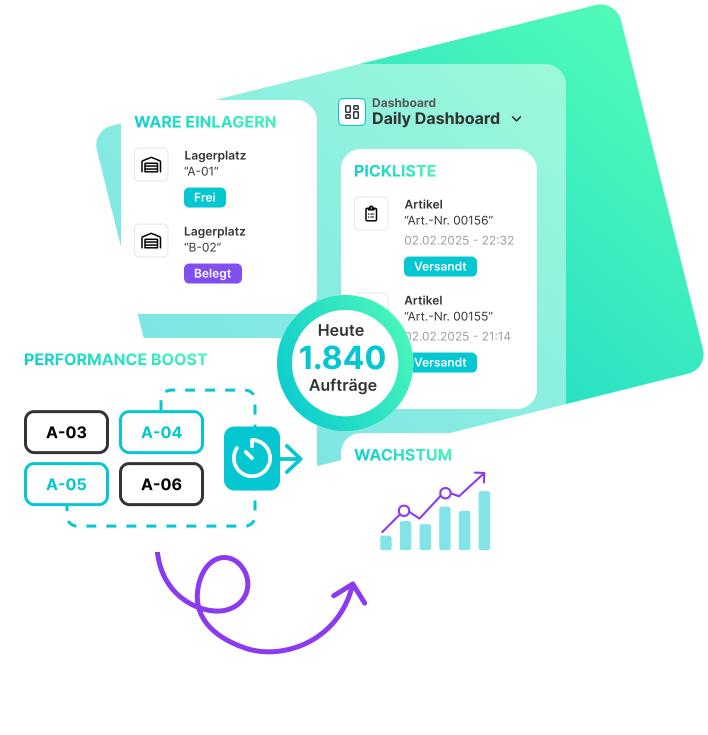
A warehouse management system (WMS) forms the central control level. It connects all devices, coordinates tasks and enables seamless data collection in real time.
Technical aids in order preparation
It is hard to imagine modern warehouses without digital support. Typical tools are
Bar code scanners and RFID systems
capture items uniquely and enable quick identification.
Pick-by-Light / Pick-by-Voice
Guidance systems that use light signals or voice instructions to show employees which items they should pick.
Mobile devices and digital picklists
replace paper documents, display real-time data and synchronize directly with the WMS.
These technologies shorten routes, prevent mix-ups and enable goods movements to be tracked precisely.
Integration of WMS, ERP and eCommerce systems
The connection between warehouse management and other areas of the company is central to a smooth data flow. Integration of the WMS with the ERP system or the eCommerce back end is possible:
- Real time inventory reconciliation
- Automatic order transmission
- Transparent process documentation
This keeps stocks up to date at all times, and the planning and purchasing departments can react promptly and efficiently.
Many systems also record additional information such as batches, serial numbers or best-before dates. This information enables traceability and quality assurance. The WMS also supports the calculation of optimal picking routes, which saves time and shortens distances.
Automated shelving systems and robotic solutions
In modern logistics centers, automated systems are increasingly taking over order preparation. Shuttle, lift and robot systems move items without human intervention. They enable high-density storage and significantly increase productivity.
One well-known example is AutoStore: a modular system in which robots travel on a grid frame and remove goods from bins. The items are automatically transported to the picking station. The advantage lies in the efficient use of space – there are no wide aisles and the storage capacity increases significantly while the area remains the same.
Such systems are particularly suitable for companies with high throughput or limited space. Although the investment is high, it often pays for itself through lower personnel costs, faster processes and a reduced error rate.
Plan fast and resource-saving order preparation
Efficient order preparation is the result of a combination of the right method, optimized warehousing and technical support. The selection of suitable strategies depends on the individual requirements of a warehouse.
Individual solutions for different requirements
Which combination of picking method, warehousing strategy and automation makes sense depends heavily on the individual framework conditions. Product types, order quantities and warehouse size determine whether work should be manual, semi-automated or fully automated.
A hybrid concept that combines different methods often offers the greatest flexibility. Digital systems create transparency, enable process analyses and help to continuously optimize processes.
Before a strategy is defined, the following points should be examined:
- Product requirements: Storage conditions, packaging, shelf life.
- Order structure: individual or collective orders, seasonal fluctuations.
- System integration: WMS and ERP integration.
- Scalability: Possibility of expansion as sales order volume increases.
By combining suitable systems, the speed, precision and cost-effectiveness of order preparation can be improved in the long term.
What is order preparation?
Order preparation refers to the process in which individual items are removed from stock and put together to form an order. It is a central component of warehouse logistics and has a major influence on delivery speed, accuracy and customer satisfaction.
What picking methods are there?
Common methods include individual picking, collective picking (batch picking), rolling order preparation, pick-to-box and pick & pack. Which method is suitable depends on factors such as warehouse size, item variety and sales order volume. In practice, several methods are often combined in order to optimize processes.
What is the difference between static and dynamic warehousing?
With static storage, each item has a fixed storage location. This ensures clear structures and makes it easier to control stock levels. Dynamic or “random” warehousing makes flexible use of available space. A warehouse management system (WMS) digitally documents each storage bin so that items can be located at any time. This system increases space utilization and speeds up warehouse processes.
How does a WMS support order preparation?
A warehouse management system (WMS) digitally controls and monitors processes in the warehouse. It assigns picking orders, calculates optimal routes and ensures real time stock reconciliation.
Integration into ERP or eCommerce systems creates a continuous flow of information from order receipt to dispatch. This reduces errors and increases transparency throughout the entire process.
What advantages does warehouse automation offer?
Automated systems – such as conveyor systems, shuttles or picking robots – speed up processes, reduce manual work steps and cut error rates. They also improve space utilization and enable efficient processing of high order volumes, even where space is limited. Automation offers considerable competitive advantages, especially with increasing demands on delivery speed and precision.
When does warehouse automation start to pay off?
Automation is worthwhile if large order volumes are regularly processed, personnel resources are scarce or the available storage space is to be used optimally. A careful cost-benefit analysis should be carried out before implementation. It is also crucial for success that the systems used are seamlessly integrated into existing processes.