Tasks & benefits of an efficient warehouse organization
A well-structured warehouse organization includes all steps from storage and order preparation to packaging and shipping. These processes affect all retailers who sell goods via online platforms and must be coordinated with each other through a functioning warehouse management system. A well thought-out organization can not only reduce challenges, but also promote independence, cost benefits and greater customer satisfaction.
With increasing order volumes, many growing online stores are reaching their limits. If processes do not keep pace with growth, delays, longer delivery times and increasing return rates occur. This can reduce efficiency and significantly increase costs.
Modern warehouse management systems can help here. They take on central organizational tasks and support retailers in saving resources, avoiding errors and optimizing processes. The result is smoother processes and more satisfied customers.
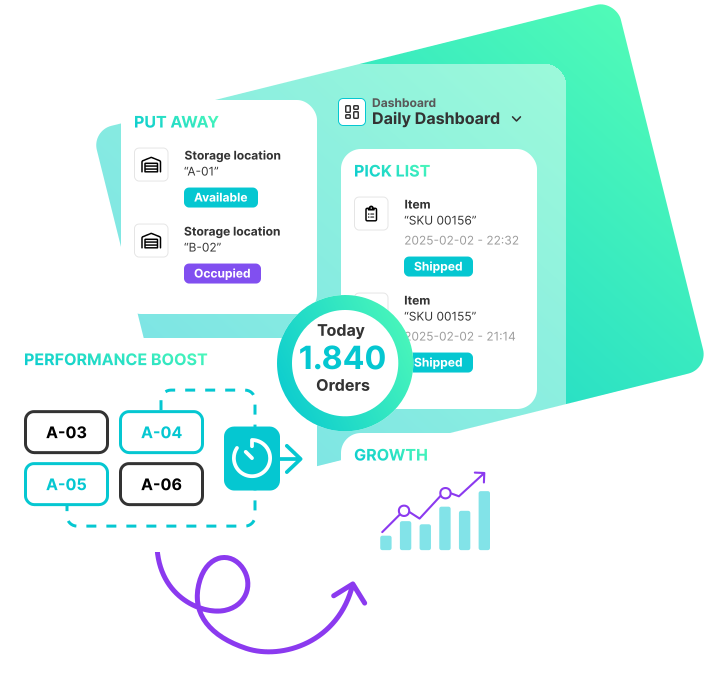
Efficient warehouse organization is the key to profitability and competitiveness in retail. It ensures that the right goods are in the right place at the right time – with minimal effort. This is not just about physical order, but also about data quality, transparency and traceability.
In the age of eCommerce, the warehouse has evolved from a mere storage location to a strategic fulfillment hub. Customers expect short delivery times, precise information on availability and smooth returns. Warehouse organization is therefore not only an internal efficiency factor, but also a direct competitive lever.
Core tasks of warehouse management
Warehouse management controls all goods movements – from delivery and storage to shipping and returns. It combines people, technology and information into a uniform process network and is the heart of logistical value creation.
Incoming goods and quality inspection
Incoming goods are the first point of contact in the warehouse process. This is where it is decided whether downstream processes will function smoothly.
All incoming goods are checked, identified, labeled and booked into the system. In addition to pure quantity checks, quality controls are becoming increasingly important – such as visual inspections, measurements or photo documentation.
Clear process documentation with checklists and bar code scanning prevents incorrect postings and increases inventory accuracy.
Storage bin management and inventory management
Storage bin management determines where an item is optimally stored. Strategic processes such as slotting (storage location optimization) are used: fast-moving items are placed in ergonomic zones, while slow-moving items are stored further away.
Digital systems automatically allocate items according to rules such as size, weight or temperature. This means that storage space is used efficiently and search times are minimized.
Ongoing inventory management ensures that all movements are mapped systematically – from goods receipt to stock transfers and order preparation.
Order preparation and shipping preparation
Order preparation (compilation of items for customer orders) is one of the most labor-intensive processes in the warehouse.
The use of suitable order preparation methods – such as batch, multi-order or zone picking – can shorten distances and avoid errors.
Structured shipping preparation includes packaging, labeling, documentation and timely handover to the shipping service provider.
Returns management and replenishment control
Efficient warehouse organization includes the returns process. Returns are recorded, checked, documented and – depending on their condition – either put back into storage or booked out.
At the same time, replenishment control ensures that picking stations are replenished in good time. Dynamic replenishment algorithms in the WMS can automatically calculate requirements and thus prevent bottlenecks.
Advantages of a structured warehouse organization
A systematically structured warehouse organization brings far-reaching benefits – in terms of business management, processes and personnel. Here are the practical benefits – each with a brief explanation:
Greater process reliability
Standardized operating procedures (SOPs), mandatory scans and defined quality checks reduce incorrect bookings, extra work and complaints.
Faster throughput times
Clear routing, order-specific placement and prioritization logic (express, same-day) shorten the order cycle time.
Cost reduction
Optimized use of space, less search time and a lower error rate reduce wage and process costs; better inventory quality reduces capital commitment.
Transparency & controllability
Real time data on inventories, open sales orders and bottlenecks enable proactive control instead of putting out fires.
Flexibility and scalability
A standardized system can respond more easily to growth, seasonal peaks or new sales channels.
Employee motivation & safety
Ergonomic zones, hands-free technologies (pick-by-voice), clear roles and feedback loops increase satisfaction, identification and reduce the risk of accidents.
Inventory management, stocktaking and replenishment processes
A modern warehouse concept is based on reliable inventory data. Only those who know what is available , where and in what quantity can manage efficiently. The aim is to achieve a balance between availability and costs.
Inventory management
The aim is to achieve a balance between availability and capital commitment. Stocks that are too high increase storage costs, while those that are too low jeopardize the ability to deliver.
Methods such as ABC/XYZ analyses help to classify items according to sales and consumption and to prioritize inventory controls.
The ABC analysis reviews the economic value of the items, while the XYZ analysis looks at their fluctuations in consumption or demand. The combination of both methods enables targeted and efficient inventory management.
Inventory procedure
In addition to the classic key date inventory, flexible procedures have become established:
- Cycle counting (permanent inventory): Regular partial counts throughout the year.
- Inventory sampling: inspection of representative article groups.
- Rolling Counts: Inventories in combination with replenishment processes.
These processes reduce the burden on day-to-day operations and at the same time ensure data quality.
Replenishment processes
Modern systems calculate requirements automatically and trigger internal transports in good time. A distinction is made between
- static replenishment (fixed defined quantities) and
- dynamic replenishment (consumption-dependent).
A transparent replenishment process prevents downtimes in order preparation and increases delivery reliability.
Quality assurance, employee involvement and continuous improvement
Process quality is not created by technology alone – it is the result of clear standards, trained employees and continuous improvement. Regular feedback loops ensure sustainable optimization of processes.
Quality assurance
Regular checks at defined points (e.g. incoming goods inspection, order preparation, random samples in shipping) are essential and ensure process stability. Causes of errors – such as missing labels, incorrect items or damaged packaging – are documented and systematically rectified.
Quality KPIs such as the error rate or complaint rate should also be documented and analyzed. The principle of root cause analysis instead of error analysis is important here: it is not the employee but the process that is improved.
Employee involvement
Employees know the practical challenges best. Their feedback on process steps, work paths and system messages is valuable for optimization.
Training, suggestion schemes and an open feedback culture promote understanding, acceptance and personal responsibility. Gamification approaches (e.g. achievement points or team challenges) also increase the motivation of employees in the warehouse.
Continuous improvement (CIP)
The Continuous Improvement Process (CIP ) is a long-term approach that aims to optimize existing processes step by step. Instead of carrying out major restructuring, small, regular improvements are implemented that have a lasting effect on efficiency and quality.
Lean methods such as 5S and Kaizen support this process. The 5S principle describes five successive steps – sort, set, clean, standardize and self-discipline – with the aim of creating order and transparency in the workplace. Kaizen stands for the philosophy of continuous improvement through the involvement of all employees.
Regular reviews, target figures and workshops with interdisciplinary teams ensure that efficiency gains are permanently anchored.
Key figures and performance evaluation in warehouse organization
Key figures create transparency and enable an objective customer review of performance. They help to control processes, identify deviations and deploy resources in a targeted manner.
Stock turnover rate
Indicates how often the entire stock was sold or processed in a specific period. Formula: Turnover / average stock.
High values indicate efficient inventory management, while values that are too low indicate capital commitment.
Space utilization
Ratio of used to available storage space. The target value is 80-90 %.
Too high a capacity utilization complicates the material flow, too low means unused potential and inefficient use of space.
Picking accuracy
Proportion of error-free order preparations in all sales orders. The ideal value is above 99 %. Systems with mandatory scanners or pick-by-light reduce picking errors.
Even small improvements have a major impact on customer satisfaction and costs.
Productivity per employee
Ratio of sales orders processed to hours worked.
It is not used for monitoring purposes, but as an indicator of training requirements and process design.
Inventory accuracy
Comparison of system inventory vs. physical inventory. Target value is above 98%. Deviations indicate process gaps (e.g. missing bookings).
Regular cycle counts significantly stabilize stock accuracy.
An efficient warehouse organization is the basis for stable processes, satisfied customers and economic success in retail and logistics.
Those who define clear processes, distribute responsibility and use technology in a targeted manner create the basis for scalability, customer satisfaction and profitability.
Companies that take a holistic view of their warehouse organization – from incoming goods inspection and inventory management to returns processing – benefit from noticeable advantages: faster order throughput, lower costs and sustainably higher delivery quality.