The first milestone has been reached: The stable release of JTL-Wawi 2.0 marks the beginning of the next evolutionary stage of JTL – the era of cloud technology. The new version of our ERP forms the technical basis for future cloud integrations from JTL and partners. These are currently still in a closed beta phase and will gradually be made available to other users.
In addition, version 2.0 provides your warehouse with a range of new WMS functions that are particularly interesting for growing warehouse and shipping structures.
In this article, we’ll show you what the new version means for your everyday business – and why it’s worth updating to JTL-Wawi 2.0.
New base version: Why “Wawi 2.0” and not “Wawi 1.12”?
With JTL-Wawi 2.0, we are introducing a new, clear versioning scheme on which all future updates will be based: semantic versioning. It follows the industry standard pattern:
MAJOR.MINOR.PATCH, e.g. 2.0.0
What does the versioning scheme actually mean?
- MAJOR (e.g. 2 → 3)
These large version jumps mark a new development step in the software, which can be accompanied by far-reaching technical changes or extensive new functions – as is now the case with the change from JTL-Wawi 1.11 to 2.0. - MINOR (e.g. 2.0 → 2.1)
These updates add new features and extensions to an existing version, which are usually backwards compatible. - PATCH (e.g. 2.0.0 → 2.0.1)
Such versions contain bug fixes, minor optimizations and security updates without introducing new functions.
For you as a retailer, this release scheme primarily creates more transparency and better planning: in future, you will be able to see at a glance whether a release mainly contains bug fixes and stability improvements or whether new functions are being added. Updates and test cycles can be prepared in a much more structured way, especially in larger teams and more complex setups – for example with connected third-party systems.
New technology stack ensures major version leap
Why is the current release a major update? With JTL-Wawi 2.0, we are converting the Application to .NET 8, which involves various new system requirements.
What are the benefits of .NET 8? The migration is not immediately visible in individual buttons or screens – but you will feel it immediately in everyday life: in a more stable and faster ERP system. This is because .NET 8 uses memory and processor resources more efficiently, making workflows noticeably smoother, especially in data-intensive processes. In many areas of the Application, performance can increase by up to 30%.
Security and maintenance also benefit from the changeover: security updates and further developments of the framework can be integrated more quickly and cleanly in future. This ensures a more stable technical basis and reduces technical legacy issues in the long term.
At the same time, the migration to .NET 8 creates a future-proof architecture that is designed for cloud hosting. It thus forms an important basis for further developing JTL-Wawi with new cloud services, integrations and interfaces in the future. The migration to .NET 10 will take place later in the year as part of a minor update.
JTL-Wawi 2.0 takes the first steps towards the cloud
The new major version opens the door to the JTL Cloud. We are taking a hybrid approach with you: you will continue to work with your usual on-prem system, but can gradually start using the first cloud listings such as JTL Archive, Returnless or the new JTL-Shipping – without having to change your entire infrastructure at once. The corresponding apps are currently in closed beta status and will be made available to you successively in the new JTL App Store, which is still under development.
But what is the JTL Cloud all about? It is a platform that bundles solutions from JTL and partners in a modern cloud environment. All services are networked via a central access point and can be flexibly expanded. While JTL-Wawi will remain installed locally, integrations will in future be provided and updated via the JTL App Store. This means that new functions will be available to you immediately, without installation effort and waiting times.
Control center for ERP, administration, apps and services
In the long term, you log in to JTL-Wawi and future cloud services with just one JTL ID. You manage all apps, employees, roles and rights of your organization in the JTL Hub interface. Thanks to the shared database, cloud services such as JTL-Archive or Returnless can access your data directly in JTL-Wawi. The connection to the cloud meets high security standards and allows you to access important services from anywhere via your browser. At the same time, the standardized integration offers noticeably more convenience for the quick integration and use of apps that will cover almost all areas of eCommerce in the future.
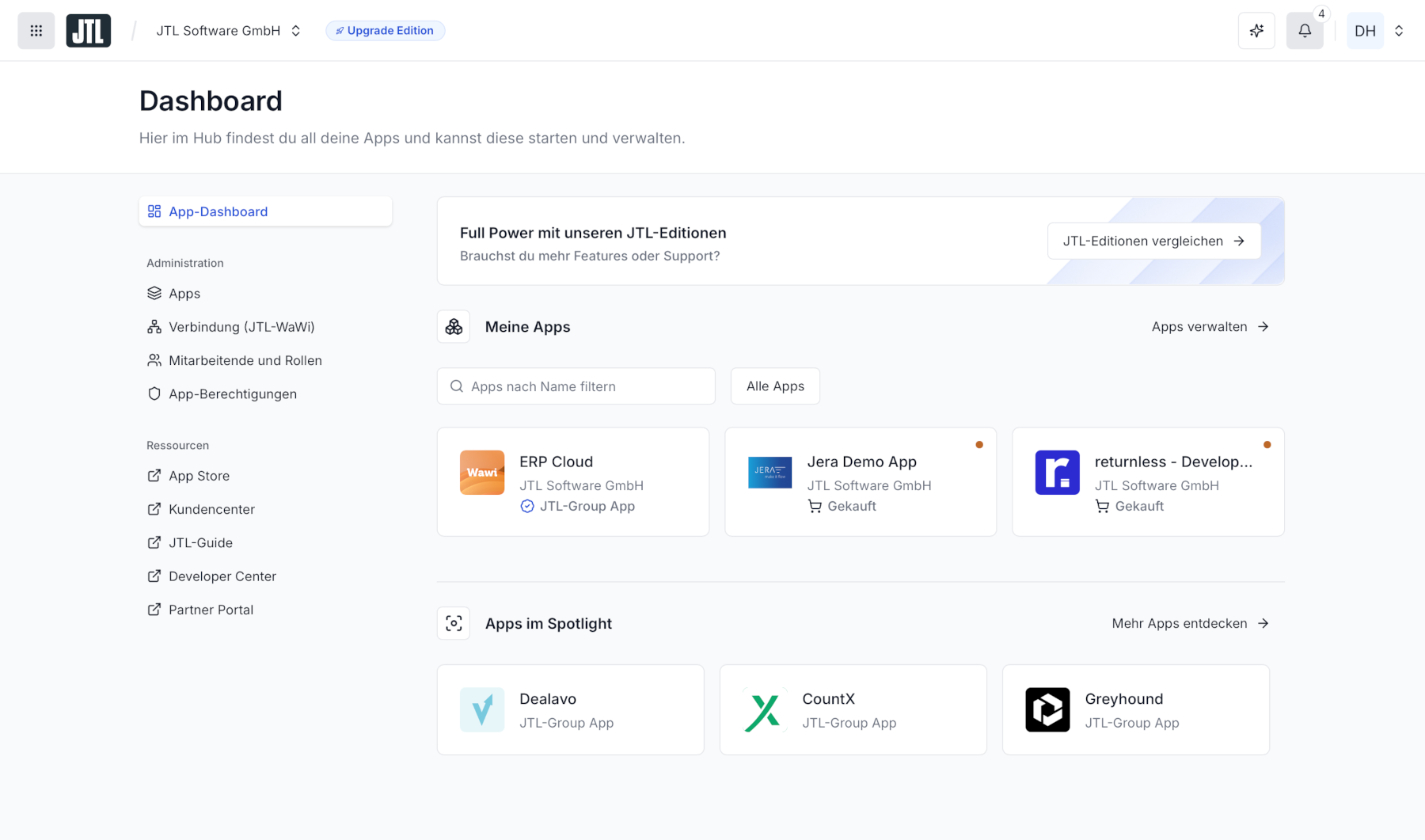
In the future, moving to the cloud will mean fewer individual systems, less operating effort and easier scalability – and by updating to JTL-Wawi 2.0, you are already laying the foundation for this today.
More information about JTL Cloud
You can find an overview of the future cloud services and further developments on our information page.
Switch to DHL Shipping 4.0 with JTL-Wawi 2.0
With the new version of JTL-Wawi, you can convert your DHL integration to DHL Shipping 4.0. This allows you to use the technical basis that complies with the latest DHL specifications. You benefit from more stable label creation and data exchange processes as well as better scalability if your shipping volumes grow or your warehouse structures become more complex. At the same time, the new interface creates a future-proof basis for further optimizations in shipping – especially in interaction with JTL-WMS.
Good to know: You can generally use the same access data for DHL Shipping 4.0 as for DHL Shipping 3.0.
Important note
DHL and DPD will soon discontinue their previous interfaces. To ensure that your shipping processes continue to run smoothly, you should update to JTL-Wawi 2.0 in good time.
You can find detailed information on switching from DHL Shipping 3.0 to DHL Shipping 4.0 in the JTL-Guide.
Shipping 2.0: Cloud-based shipping and tracking platform directly in JTL
From version 2.0, the new Shipping 2.0 will be integrated into JTL-Wawi – a cloud-based multi-carrier platform that consistently merges labels, returns, export and customs documents as well as shipment tracking and seamlessly integrates them into your existing JTL processes. You can control your entire logistics across all parcel services via the central shipping service provider connector – rule-based and robust.
The new Shipping 2.0 is expected to enter open beta in Q2 (subject to change). Further expansion stages and the stable status will be communicated separately. Subscribe to our newsletter to make sure you don’t miss out on any new products.
JTL Archive: Audit-proof document archiving from the cloud
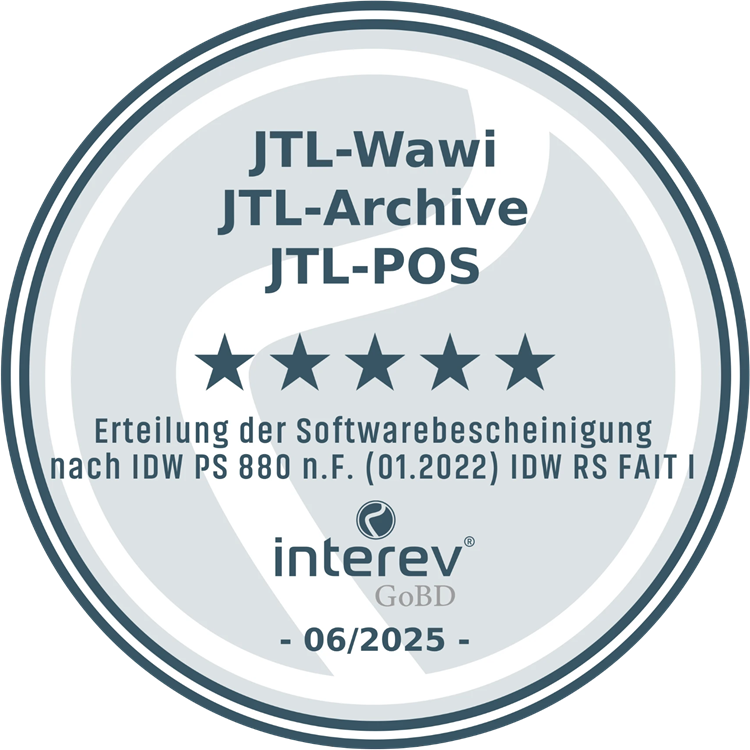
With JTL-Archive, we are introducing the first cloud service that archives your outgoing documents created in JTL-Wawi in an audit-proof manner. As soon as JTL Archive is set up, the documents are automatically transferred to a GoBD-compliant archive in the background via the cloud – without any additional manual effort. This allows you to keep track of the status of your document archiving at all times, all business transactions remain fully traceable and you are on the safe side in the event of a tax audit.
Become a JTL Archive beta tester
Before JTL Archive becomes available to all users, we are launching a closed beta phase with selected customers. If you would like to participate, you can log in to the pilot program in the JTL-Customer Centre. You can find more information about the pilot phase in the JTL forum.
New functions for JTL-WMS: More thrust in outgoing goods
Regardless of the new cloud platform, the release of JTL-Wawi 2.0 provides important enhancements in JTL-WMS that make shipping processes more efficient, scalable and smooth – a plus point for anyone who moves a large number of parcels every day.
Parcel content tracking for multi-parcel shipping (from WMS Pro)
In future, the traceability of package-specific content will ensure greater transparency – both internally in the warehouse and vis-à-vis customers and partners.
Dispatch table (from WMS Pro)
With the new shipping table, you can now split the packing process between two employees – reducing errors when shipping volumes are high.
Forwarding module (WMS Enterprise)
As of JTL-Wawi 2.0, forwarding shipments are also systematically supported by JTL-WMS, so that the shipping of bulky goods or palletized goods is much more structured.
Shipping lines (WMS Enterprise)
The integration of the shipping line enables fully automated shipping processes and flexible scaling.

Start the next generation of JTL-Wawi now
The update to JTL-Wawi 2.0 is particularly worthwhile for eCommerce companies with growth plans. If you want to prepare your system landscape for upcoming cloud services and apps at an early stage and at the same time further professionalize your warehouse logistics, version 2.0 will provide you with the necessary foundation. With an update, you can also ensure that the shutdown of important DHL and DPD interfaces does not lead to serious problems in your shipping process.
Our recommendation is therefore: Upgrade to JTL-Wawi 2.0 as soon as possible. This is the only way to benefit directly from new functions and future cloud services. Older versions of JTL-Wawi will reach their end-of-life after a transition period and will no longer be developed further.
JTL-Wawi 2.0 is now available as a stable release.