You think brand protection is only for the big players in eCommerce and not relevant for you? The opposite is true! In a fast-moving and highly competitive environment such as online business, it is crucial to protect and strengthen your own brand. In this blog post, we show why protecting your own brand is not just an important legal aspect and what you need to consider when logging in.
Legally secure online business:
In the JTL Extension Store you will find a large selection of plugins and extensions for legal and security issues
Trademark registration - is it really necessary?
As an online retailer, your success depends to a large extent on your reputation. However, without a trademark registration, you are not protected from a third-party retailer using the same brand name and not only snatching away potential customers, but also negatively affecting your reputation through lower product quality and poor service. Retain control of this important marketing tool, which strengthens the image and identity of your retail business.
This protection can also be of crucial importance for your multichannel trade, as the problem of counterfeit products is omnipresent on marketplaces such as Amazon or eBay. A trademark application can be crucial for taking legal action against counterfeiters. By logging in and protecting your trademark, you can prove that you are the rightful owner and take action against people or companies who try to use your trademark without permission or sell counterfeit products.

Some platforms also require sellers to provide proof of branding, especially when it comes to selling certain branded products. A registered trademark facilitates access to these marketplaces and can improve the credibility of your seller profile.
In addition, you should not underestimate the increase in the value of your company that comes with registering a trademark. You can view a registered trademark as an asset – especially if it enjoys a high level of recognition and a good reputation.
You take these risks without registering a trademark:
Of course, you are free to decide against registering a trademark because you consider the risk of your products being counterfeited to be low, for example. However, you must bear in mind:
If you use a sign as a trademark to identify your goods that has not been registered and researched by you, you run the risk of infringing third-party property rights.
And even if the sign you use is not protected by the rights of third parties, there is always the risk that a competitor will secure the rights to it before you and thus block you from using it.
A trademark is used to identify and protect the goods or services of a company. It makes a company’s products distinguishable from those of other companies. Trademark applications can be filed at various levels:
- National trademark: protection at national level
- EU trademark: Protection at EU level
- International Registration (IR): Protection at international level
All signs such as words, names, images, letters, numbers, sounds or three-dimensional designs can be registered as trademarks. Even designs, including colors and color combinations, can be protected. Each of these types of trademark requires graphic representability in order to be included in the trademark register.
You should bear this in mind:
Even if most of the arguments speak in favor of a trademark application, there are a few points that you should be aware of in advance:
How does trademark protection come about?
When trademark protection arises is precisely defined by law, namely in § 4 MarkenG:
In Germany, trademark protection arises in accordance with the German Trademark Act (MarkenG) when the trademark is entered in the trademark register at the German Patent and Trademark Office (DPMA). Through this registration, the trademark owner acquires the exclusive right to use the trademark for the goods and services specified in the registration.
Trademark protection can also be acquired through use without the trademark being registered. This is referred to as “customary trademark protection”. This arises through use in the course of trade, provided the trademark has general recognition in the market, i.e. is recognized by many people as a sign for certain products. However, it can be very difficult to enforce this protection.
In this context, notoriety means that a trademark that has achieved an exceptional reputation in a specific market segment or in general enjoys extended protection, even if it is not used in this specific market segment. Notoriety can play a particularly important role in cases of product piracy or trademark infringements, as it provides the trademark owner with extended protection against counterfeiting and misuse of their trademark.
Even if officially logging in a trademark is not the only way to protect it, it is undoubtedly advisable to do so. Protection through use or notoriety is rarely clear-cut and, in the event of a dispute, involves high costs and an uncertain outcome.
How do I log in a trademark?
Once the decision has been made to log in the trademark, the login process is as follows:
How much does a trademark application cost?
The costs for logging in a trademark may vary depending on the country in which the login is made and on the scope and complexity of the trademark protection application and consist of a filing fee and, if applicable, additional fees for the classification of the goods.
Many companies hire a trademark attorney or a trademark agency to carry out the login of their trademark. The associated costs vary depending on the provider and the scope of the service.
If you log in the trademark in a country where a different official language is used, translation costs may be due.
Also bear in mind that once the trademark has been registered, there are ongoing fees for maintaining the registration and renewal costs.
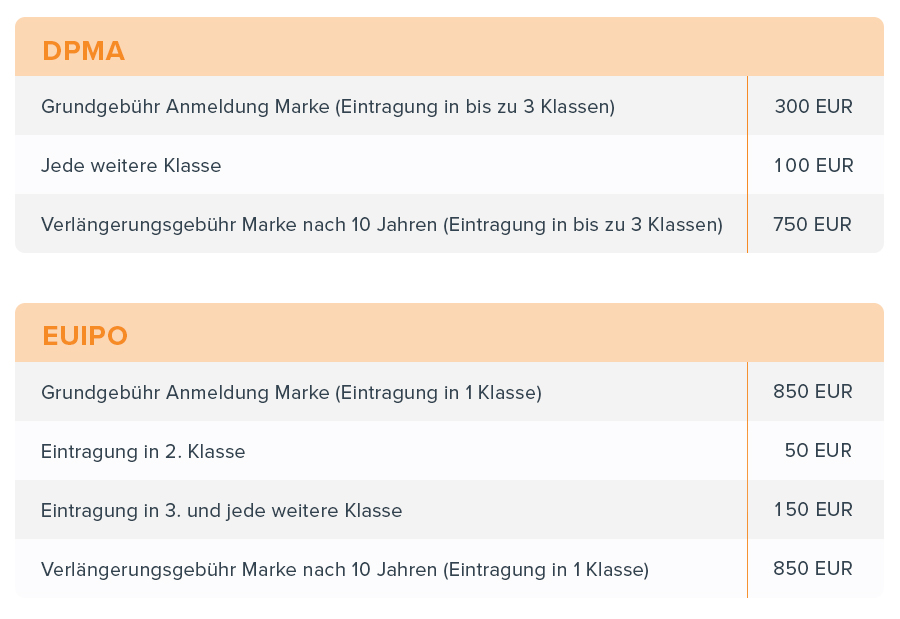
To the complete list of fees of the DPMA and to the fee calculator of EUIPO
How long does the protection period last?
A registered trademark, whether for Germany (German trademark) or the EU (EU trademark), begins on the date of logging in and expires after 10 years. Anyone wishing to maintain the protection of the trademark must file an application for renewal for a further 10 years or pay the renewal fee, otherwise the protection expires.
Take the first step now to protect your brand
Brand protection is an essential aspect for the long-term success of your online business. It protects you from financial damage and the loss of your reputation while increasing the value of your brand.
Would you like detailed advice on trademark law or other legal issues in eCommerce? The IT law firm will be happy to advise you!