Before you ship your goods as an eCommerce business, you should ensure that the products are not only packaged safely, but also sustainably. Because if you optimize your processes in terms of environmental compatibility, you not only conserve resources and improve your ecological footprint, but also save costs in the end. This is particularly important in view of the upcoming new EU packaging regulation (EU-VerpackV) and the plastic tax that will be implemented in Germany from 2025 in order to position yourself as a future-proof company.
Green packaging revolution
From 2025, a new law will come into force with the EU Packaging Ordinance, which will uniformly regulate the placing on the market, return and recycling of packaging in all member states. Unlike the previous Packaging Directive 94/62/EC, the upcoming regulation will apply throughout the EU without the need for transposition into national laws. After the European Parliament accepted the draft for the new law in April 2024, the EU Council of Ministers has yet to give its approval, which is expected to follow in the fall.
As part of the European Green Deal, the new regulation primarily stipulates updated criteria and characteristics for the recyclability of packaging: Once it comes into force, all packaging materials must be recyclable on a large scale, i.e. using existing infrastructures and processes for collecting, sorting and recycling packaging waste. The regulation also specifies the minimum recycled content that plastic packaging must contain in future, graded according to the intended use and source material. With the plastic tax, on the other hand, a national levy of 80 cents per kilogram will be payable on non-recycled plastics from next year – and this will affect all so-called first-time distributors, i.e. companies that manufacture, import, sell or fill disposable plastic packaging for the first time.
Due to these upcoming regulations, it is therefore a good idea to rethink your packaging processes now. The following tips will provide you with initial solutions on how you can reduce your material consumption, cut costs and minimize breakage and return rates at the same time.
1. correct outer packaging
As the first layer of protection against mechanical damage, the outer shipping packaging has to withstand a lot. Cardboard is therefore the ideal solution for sensitive goods. This usually consists of corrugated cardboard, i.e. a multi-layered combination of smooth and corrugated paper. The more of these layers the cardboard has, the more stable it is. Single-wall versions are particularly impressive due to their low weight and are ideal for lightweight goods due to their relatively good shock absorption. Multi-wall versions, on the other hand, offer good stackability and reliably protect even heavy shipping goods. Cardboard boxes can be easily recycled via the waste paper disposal system, thus protecting both the environment and raw materials.
2. optimized filling level
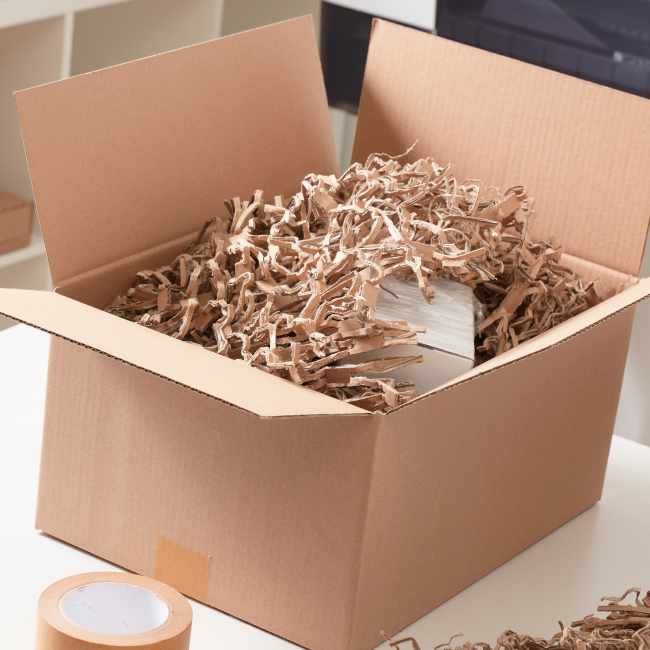
To ensure that you don’t waste any material and therefore don’t have to bear higher disposal costs, you should choose the right box size for the product and make sure you use the right amount of filling material. Good practice here is to stick to the two-finger rule: about two finger widths from the product to the cardboard wall are ideal. This way, you still have enough space for padding and are not forced to use more filling material to prevent the goods from slipping in the parcel. This is because the German Packaging Act (VerpackG), which has been in force since 2019, obliges first-time distributors to contribute financially to the recycling of packaging. How high the costs are depends on the quantity put into circulation. So unless you want to pay more, you should avoid using huge boxes full of filling material.
3. suitable posting
We currently recommend two leading systems in the area of padding and filling – air cushions and paper cushions. Both have different advantages and are therefore suitable for different applications:
- Paper pads
1. are made from renewable raw materials or recycled paper
2. can be reused several times
3. can be easily recycled
4. offer optimum protection against vibrations and shocks
5. are perfect for heavy and sharp-edged products
6. are uncomplicated and flexible in their application - Bubble cushions
1. are very lightweight
2. use little material in relation to their volume
3. are dust-free and water-repellent
4. are made from up to 100 percent recycled material
5. have a lowercarbon footprint than paper
6. can be removed from stock to save space
Paper cushions are particularly recommended for heavy goods and products with sharp corners or edges. Air cushion pads, on the other hand, are particularly suitable for sensitive surfaces as well as electronic devices or pharmaceutical items that require dust-free packaging.
Future-oriented and efficient
Sustainable packaging solutions are essential for the eCommerce industry, not only for ecological reasons but also from an economic perspective – all the more so in view of the introduction of the new EU packaging regulation and the upcoming plastic tax. Companies should therefore proactively focus on recyclable and resource-saving shipping options at an early stage in order to both reduce their costs and improve their environmental footprint. A well-thought-out packaging strategy that takes into account the right filling level, the right outer packaging and the right cushioning material is the key to future-proof and responsible shipping. For the optimal development of such a strategy and to ensure a smooth transition, it is best to contact an experienced packaging service provider.
The experts at BB-Verpackungen will of course be happy to provide you with further information.