From June 19, 2026, many online retailers in the EU will have to provide an electronic withdrawal function – often referred to as the “withdrawal button”. The aim is to make it just as easy for consumers to cancel a purchase online.
- Mandatory from 19.06.2026: Withdrawal must be possible directly online via an online user interface for distance selling contracts concluded online.
- Two steps are provided: first “Revoke contract”, then “Confirm revocation” (or equivalent).
- Confirmation by “durable data medium”: After sending, the customer must immediately receive a confirmation of receipt, e.g. by email (including content, date and time).
- Don’t wait until June: Planning early saves stress – because in addition to technology, processes and legal texts are also affected.
- JTL-Shop: The possibility of implementation will come as planned with the new version JTL-Shop 5.7 in March 2026.
What is the withdrawal button in online stores?
The “revocation button” is the planned legal obligation to offer a revocation function that can be used online – directly where the contract was concluded online (website/app/interface). The customer should therefore no longer have to laboriously set up their withdrawal by email or search for a form, but should be able to trigger it digitally in a standardized way.
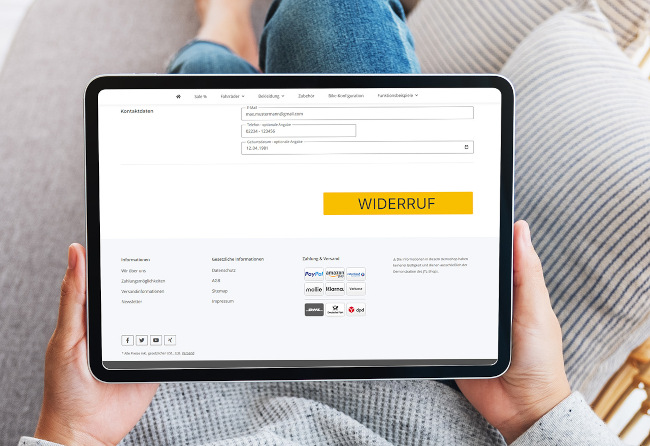
The term “button” is colloquial. In legal terms, it refers to a revocation function – in practice, this will usually be a clearly visible button or an equally clearly highlighted link.
When is the revocation button mandatory?
According to EU requirements, the national rules must be applied from June 19, 2026. This date for the application/start of the new revocation function is also taken up in the German legislative process. (Details may still change in the final legislative text – however, the basic requirements and the start date are clearly set out).
Who is affected by the revocation button?
Online retailers who conclude distance contracts with consumers (B2C) are affected if the contract is concluded via an online user interface (classic: online store, mobile store view, app, embedded checkout, platform interface).
Pure B2B stores, where end consumers are excluded, are not affected. Also important: The obligation is linked to the existence of a right of withdrawal. If there is no right of withdrawal for certain products/services (e.g. personalized goods, perishable goods, unsealed hygiene articles), then no withdrawal “by button” can be exercised – the correct legal classification is decisive here.
What requirements apply to the revocation function?
The planned requirements are very specific – and are deliberately reminiscent of the logic of familiar “button solutions”.
What is changing besides the technology?
The withdrawal button is not just “a feature”, but also affects your information obligations. You must provide information about the existence and placement of the withdrawal button in the withdrawal policy from the effective date.

The privacy notice must also be adapted. This must include which data is collected, processed and stored as part of the revocation (observe GDPR).
What should online retailers do now?
Even if you can’t yet activate the button “click-ready” in every system: Most of the construction sites are preparatory work.
Frequently asked questions about the 2026 revocation button (FAQ)
Application of the EU requirements will apply from 19.06.2026.
The legal/guideline approach speaks of a revocation function that is clearly marked and easily accessible – in practice, this is usually implemented as a button, but depending on the design, it may also be conceivable as a clearly highlighted link. The decisive factor is clear labeling (“Revoke contract” or similar) and prominence.
Yes – there are no exceptions depending on the size of the company.
No – the new obligation is aimed precisely at ensuring that revocation is possible directly online via the user interface. Other channels (email, sample form) remain important, but do not replace the online function.
A two-step process is envisaged with final confirmation (“Confirm revocation”) and then an immediate confirmation of receipt on a durable data medium (e.g. email) including date/time.
Yes, as soon as the contract is concluded via an online user interface, the new right of withdrawal will apply from June 2026. However, marketplace operators such as Amazon & Co. are obliged to implement this.
Yes: The button refers to contracts for which there is a right of withdrawal. In the case of goods/services for which the right of withdrawal is excluded by law, the obligation does not apply. The exact distinction is legally sensitive.
Note: This article does not constitute legal advice and does not replace an individual examination by a law firm.