Part 2 of the blog series: SEO for online stores
The secret of a good SEO strategy lies in convincing both search engines and (potential) customers with your content. After highlighting the benefits of a good information architecture in the first article of our four-part blog series “SEO for online stores”, we will focus on the design of your content and content markup in the second part. In particular, the aim is to present your content and texts to search engines in such a way that they can better understand, categorize and review them.
Why is well-prepared content so important for online stores?
The content that you publish in your online store fulfills important functions. First and foremost, it serves to provide your store visitors with targeted information. You should always keep this point in mind, as efforts to improve search engine rankings often come at the expense of the conciseness and readability of texts. This happens, for example, when so-called keyword stuffing is practiced, in which site operators try to include as many keywords as possible in a text, turning it into a soulless wasteland.

On the other hand, your content should provide a sufficient number of relevant signals for the search engines. Put simply, their bots scan and search your online store at regular intervals and then evaluate how the information found ranks in the index in terms of quality and uniqueness. Accessibility and barrier-free accessibility also play an important role here, as people who use your online store with the help of voice output devices, for example, are dependent on structured and clearly labeled content in order to understand it.
With the right mix of high information content, accessibility for search engines and a consistently positive user experience, you will gain a sustainable competitive advantage. The quality of your content lays the foundation for this.
Avoid duplicate content - show your expertise!
In an online store, there are some areas that can contain a lot of helpful text, e.g. the product descriptions or higher-level (category) texts that describe your product range or your online store in more detail. These texts are ideal for integrating relevant search terms for the topics you offer.
To ensure that you land in the top positions on the desired search result pages (SERPs), you not only need the right keywords – unique content with high added value is just as important. So please take care not to publish duplicate content, e.g. by copying the manufacturer’s product descriptions one-to-one or copying texts and pasting and displaying them unchanged on several pages. Above all, it is high-quality and distinguishable content that will appeal to your visitors and be rewarded with good search engine rankings.

In order to create this unique content, you should always focus on the search intention of your store visitors: What exactly are they looking for? What information do they need to satisfy their need for information and make a purchase decision? And how can you prepare the content to present your products in a particularly attractive way? Where do you need descriptive texts and where do you need more emotional texts? Are your own high-quality images useful or even explanatory videos?
Topics that you discuss in a blog or advice section connected to the online store, for example, also position you as an expert and can lead interested readers directly to the product and, in the best case, initiate the ordering process.
What rules apply to content labeling?
Content markup means labeling the information of digital content in a way that is easy to understand and catchy for search engines and users alike. To do this, you should adhere to certain rules when preparing content in order to send clear and unambiguous signals to search engines and at the same time ensure optimal readability for your visitors. Here are five essential points:
1. title tag and meta description
The careful selection of a page-specific title tag and a suitable meta description are among the most important SEO tasks for your online store. For search engine users, these details are often the first point of contact with your store and should therefore be attractively designed and encourage them to click. The structure of an optimal snippet that is displayed in the search results is shown in the following graphic:
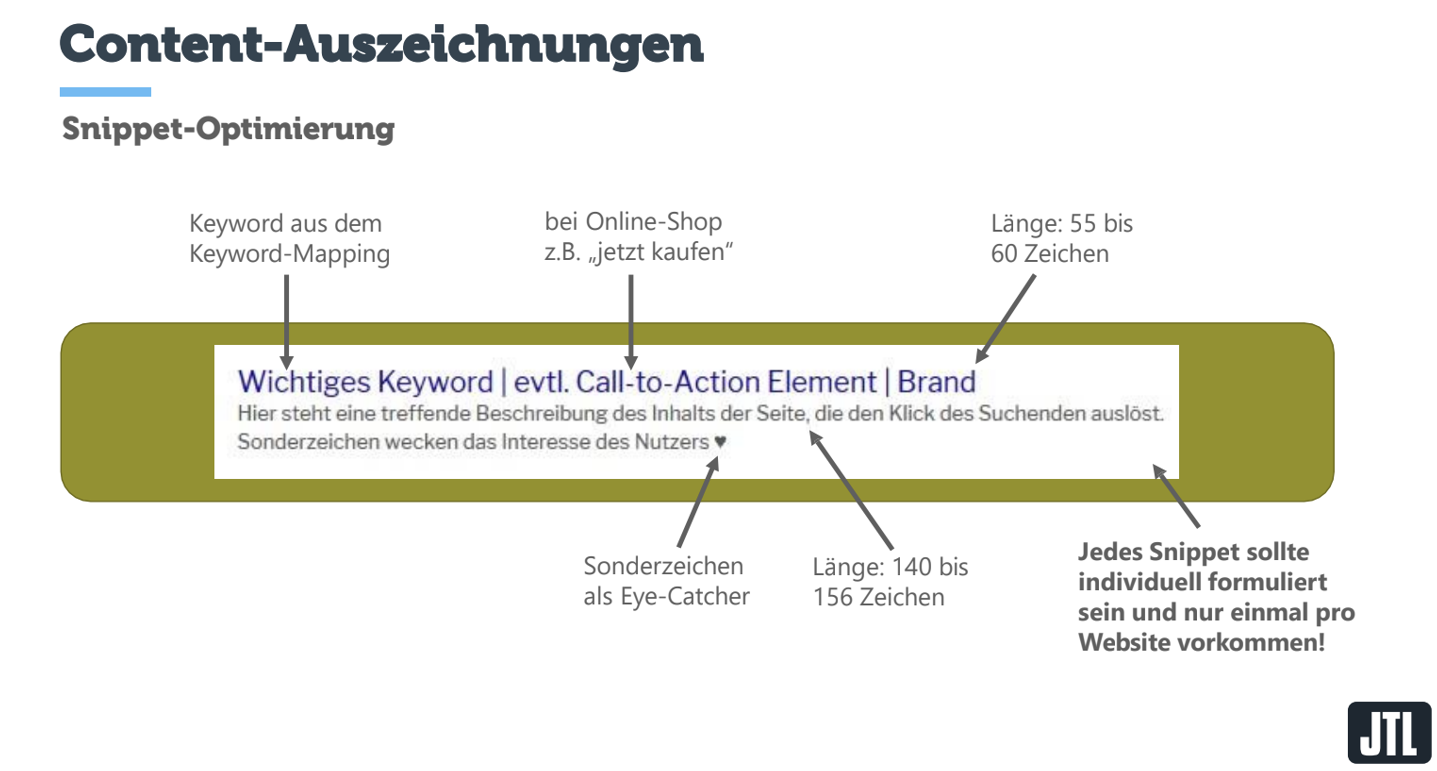
If necessary, think about a meaningful scheme that suits your product range and your target group. To make a snippet particularly appealing, you can, for example, insert the price of your listing in the title or use emojis in the title or meta description. It is also advisable to emphasize the USP of your store or your product, i.e. what sets you apart from the competition.
2. headline structure
The arrangement of your content should follow a stringent hierarchy. The main heading H1 summarizes what the page is about. A subsequent H2 indicates what to expect in the next paragraph. If your content allows it, you can also nest even deeper with H3 and H4. You should include important and thematically relevant keywords within the headings. Synonyms are also welcome here. This hierarchy ensures clarity and overview for humans and machines and guarantees that the content is quickly understood when the page is scanned.
3. use of lists
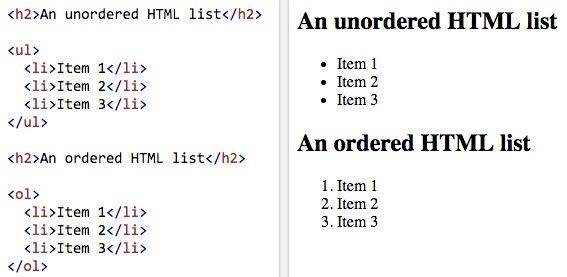
The use of lists also promotes the clarity and emphasis of your content. By using <ul> (unordered list), your content is organized by key points, <ol> (ordered list) sorts them by order or importance by 1st, 2nd, 3rd, etc.
4. internal linking and link texts
Internal links that refer to further relevant content within your online store signal thematic connections to search engines and at the same time guide visitors through your online store. Concise and clear anchor texts that indicate where they lead are important for the design of your internal links. So instead of writing “Click here” or “Learn more“, you should rather use a text like “Download free SEO guide”.
5. structured data
By providing structured data, you create the conditions for appearing in search engine results with so-called “rich snippets”. These can be, for example, reviews, videos, FAQs or certain product-specific information that you can include. This information helps search engines to better understand and categorize the content of your website and your listing.
If Google classifies the additional data as useful, it is displayed prominently in the results as rich snippets. This form of presentation is much more appealing to searchers and Google users and significantly increases the chances of getting the desired click.
The following graphic shows rich snippets in Google search results that display a product image, name and color as well as star ratings, price and availability.
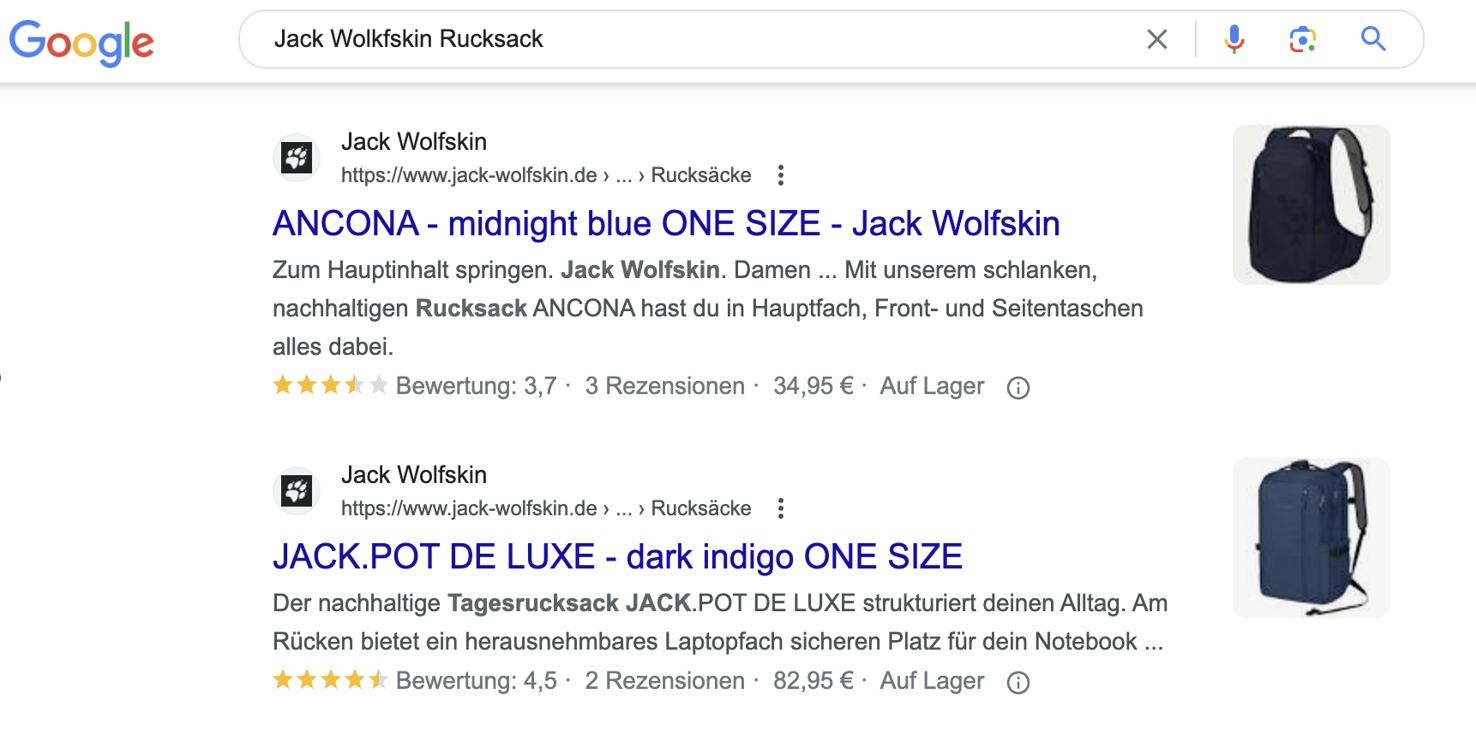
You maintain the respective structured data via so-called schema markups. In the example above, for example, a product markup is read out. The easiest, most reliable and quickest way to implement schema markups is to use appropriate plugins. On the schema.org website, however, there is also a large library of all available data types that can be used as templates. You can copy these and adapt them to your own data. You can find out how this works and exactly how you should proceed here in the Google documentation on structured data.
With the use of structured data and the display of rich snippets, you increase the attention for your content, improve the click-through rate (CTR) and ensure an overall increase in qualified traffic to the product detail pages of your online store.
How do you optimize images for Google & Co.
Especially in an online store, images are the be-all and end-all to illustrate the design and function of your products to potential buyers. Here, too, there are a few rules to follow on how to prepare your images optimally and make them findable for search engines. Our blog post Image SEO for JTL-Shop: 7 tips to increase your sales explains everything you need to know about SEO for images.
Man before machine
Entire books have already been written about SEO in general and content marking in particular. Our item can therefore only provide a small but important excerpt on this topic. However, we would like to mention one thing at this point: Even if it seems tempting to use lots of keywords and “perfect” your content, your content should first and foremost be written for people, their understanding and their needs. You can be sure of this: Google can measure many things and will sooner or later reward such a basic understanding and approach from you. Your texts should therefore make people want more and, in addition to all the technically necessary details such as keywords and hierarchy levels, should also be very emotionally appealing and convincing.
In the third part of our SEO blog series, we look at the technical aspects of your online store and explain how you can make them SEO-friendly.
All posts in the SEO blog series at a glance:
Part 1: Information architecture in the online store
Part 2: Content – preparing content optimally
Part 3: Technical SEO to improve performance
Part 4: Artificial intelligence: areas of application SEO