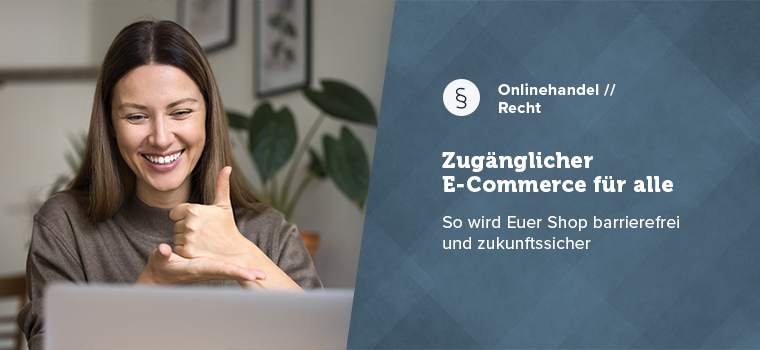
E-commerce is no longer just about offering a wide range of products or ensuring a smooth checkout process. One aspect that is becoming increasingly important and is still underestimated by many is accessibility. The topic will become relevant for every online retailer from June 28, 2025 at the latest, when the Barrier-Free Accessibility Reinforcement Act (BFSG) comes into force. But what exactly does accessibility mean in online retail, what are the legal requirements and what opportunities does it present for you? This article gives you an overview and shows you how you can benefit from it.
Accessibility in online retail - what does that mean?
Accessibility means that your website or online store is accessible to all users, regardless of whether they have an impairment or not. This applies, for example, to people with visual impairments, hearing impairments or motor impairments. They must be able to navigate your website, understand information and make purchases – ideally just as easily as people without disabilities.
Why accessibility is important now
Accessible e-commerce is not only an ethical issue, but is also becoming increasingly relevant from a legal perspective. Since the ratification of the UN Convention on the Rights of Persons with Disabilities in Germany in 2009 and the Accessible Information Technology Ordinance of 2011, there have been clear guidelines for the design of websites. Even more importantly, the European Accessibility Act (EAA) will come into force on June 28, 2025. This will force companies that offer products or services in the EU to make their online presence accessible.

The EAA applies not only to online stores, but also to mobile applications and services such as internet and video telephony, banking services and e-tickets. Online retailers who do not meet these requirements not only risk warnings and fines of up to 100,000 euros, but also considerable damage to their image and loss of customers.
What you can do now
There are various steps you can take to meet the requirements:
Opportunities for your online business
Perhaps you are wondering: Why should we be concerned with accessibility now? In addition to the legal requirements, there are other good reasons why accessible design can give you a clear competitive advantage.
- Extended target group: According to the German government’s Third Participation Report, around 10.4 million people with disabilities live in Germany. Many of them encounter barriers online and are unable to use certain websites. By making your online store accessible, you open yourself up to a completely new customer group.
- Improved search engine optimization (SEO): Accessibility and SEO often go hand in hand. The adjustments you make to make your website accessible – such as clear structuring, well-labeled images or semantically correct HTML – also help search engines to better understand your content. This can lead to better rankings in search results.
- Innovation and better user experience: Many measures that contribute to improving accessibility have a positive impact on the overall user experience. Websites that are well-structured, easy to navigate and usable for everyone offer a better user experience for everyone – not just for people with disabilities.
- The curb-cut effect: The so-called “curb-cut effect” describes the phenomenon whereby a measure that was originally developed for a specific group ultimately benefits everyone. A classic example is lowered kerbs, which were originally intended for people with wheelchairs, but are now also used by parents with baby carriages or people with bicycles. In the same way, accessible web design can enable all users to use a website more comfortably and efficiently.
Accessibility with JTL-Shop
Of course, it is important to us at JTL to make our contribution to making e-commerce accessible to everyone. That is why we are currently working hard to ensure that our solution meets all BFSG requirements. From the release of JTL Shop 5.5, you will be able to easily set up your store in compliance with the guidelines using the Nova template. The new version is expected to be available from March 2025. It’s best to register for our newsletter so that you don’t miss any updates!
Conclusion: Accessibility is not a "nice-to-have"
Accessibility in e-commerce is not a trend that you can ignore. It will be legally binding from summer 2025 at the latest, and the consequences of non-compliance can be severe. In addition, making your website accessible offers you the chance to reach new target groups, improve your visibility in search engines and optimize the user experience for everyone.
Sources and further links:
www.bundesfachstelle-barrierefreiheit.de/faq-bfsg
Report of the Federal Government on the situation of people with disabilities in Austria 2016
EN 301 549 V3.2.1 (2021-03) Accessibility requirements for ICT products and services
https://webaim.org/projects/million/
Barrier-free Information Technology Ordinance of September 12, 2011
https://www.parlament.gv.at/dokument/XXVII/ME/225/fname_1469270.pdf