
For one in two online shoppers, customer reviews play a key role in their purchasing decision – for 16 to 29-year-olds, the figure is as high as two thirds, according to a Bitkom study from 2020. But what if customers prefer to express their satisfaction with silence instead of stars? In this article, we reveal how you can encourage your customers to give you more feedback.
Customer ratings as a source of trust ...
Why are customer reviews so important for your business? As herd animals, we like to orient ourselves by the behavior of others. Customer reviews are therefore a guide for customers. On marketplaces such as Amazon, they can also become a unique selling point. If the price and listing are similar, the down payment of customer reviews can make the difference to the competition.

... and SEO factor
What’s more, customer reviews have now become ingrained in the logic of the internet as part of the algorithms of Google, Facebook & Co. This often leads to a chain reaction: the more positive customer reviews a provider has, the more often it is accessed and also rated. As part of the so-called social proof, customer reviews are therefore also crucial for visibility and an important area of search engine optimization.
Promoting and managing customer reviews – also known as review marketing – should therefore be an integral part of your business strategy. But where is the best place to start?
Create rating incentives in the online store
With yourselves! It is easiest to encourage visitors to leave customer reviews on your own channels. The trick is to place the feedback options prominently without being intrusive. In the worst case, intrusive pop-ups can lead to a purchase process being abandoned. The rating button in the footer of the website has established itself as the standard. However, don’t shy away from asking for customer feedback elsewhere – for example with a banner on the homepage.
More customer feedback with JTL
In your online store, you should also offer customers the opportunity to review each item individually – for example via a star bar as an eye-catcher at the top of the product page and as free text for detailed reviews under the product description. As your eCommerce solution provider, we at JTL have always considered customer reviews when developing our shop system JTL-Shop. They are an integral part of the marketing and SEO functions and can be precisely filtered, evaluated and analyzed in the back end.
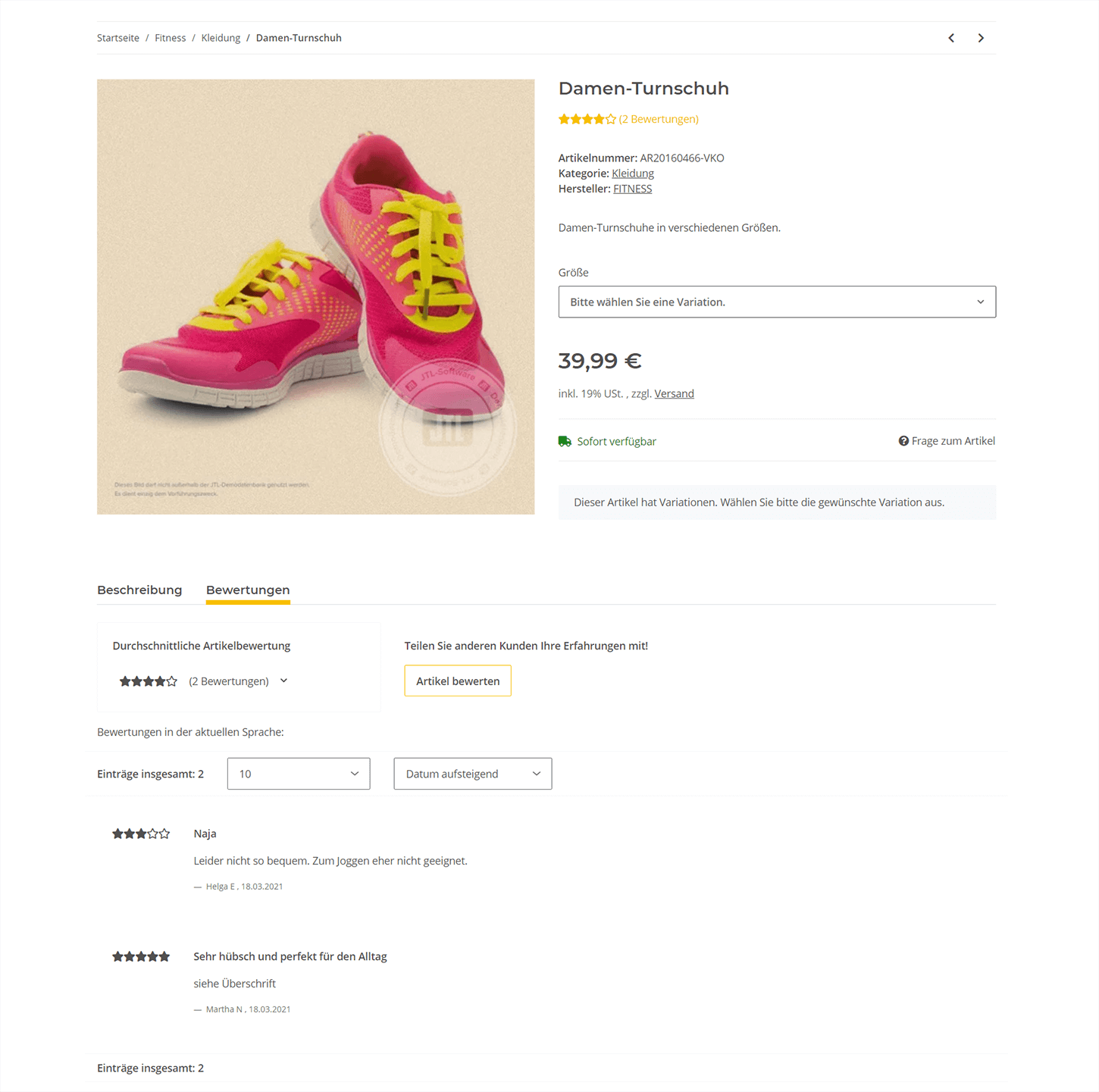
In the basic template of JTL-Shop 5, online shop visitors can immediately see the average star score and the down payment of comments for each item. To get an even quicker picture of the listing, there is the option to filter by the most recent and most helpful customer reviews. This gives you transparency and credibility and allows you to immediately see which products are best received by your target group.
Do you already have a good customer review score and want to place it prominently? You can find the right extensions for this in our Extension Store.
In addition to your own online store, there are other channels you can use to push customer reviews:
After-sales emails can provide the opportunity for very specific feedback after a purchase process has been completed. A ready-made form or a multiple-choice question makes it particularly easy for customers to share their experiences. For you, such a structured database is in turn a wonderful basis for analysis.
Do you already have some existing customers who you inform about the latest products and promotions via newsletter? Then make the customer review button an integral part of your email signature and ask readers for feedback in the text itself from time to time.
For customers who like it analog, a flyer creates an incentive for product reviews – preferably with a QR code to the review form. This ensures a seamless media transition.
Newsletters can also link wonderfully to social media channels such as Facebook. Users can also rate companies and brands here. Good news: Facebook’s high user numbers mean you can reach a particularly large number of people. Reviews usually appear quite credible there because many users are logged in with their real name and profile photo.
Last but not least, you can also ask your customers directly for feedback – the service and support team has a “direct line” to them. Teach your employees how important customer reviews are for business success and that timing is everything: it’s best to ask for a review after a problem has been solved.

Customer reviews on Amazon
As many retailers also offer their goods on Amazon, we want to take a closer look at the customer review system of this marketplace: Amazon places particular emphasis on its customer ratings in order to create the greatest possible comparability. Amazon is also used by many users for product research due to its sheer size. The company therefore attaches great importance to honest and genuine customer reviews and weights their importance for the search results list accordingly.
If you want to try to push your Amazon reviews, you should familiarize yourself with the Amazon guidelines on product reviews beforehand, as a violation can result in the deletion of your seller account. As a retailer, you can ask for a customer review by email between four and 30 days after completing a purchase. In addition to the product reviews, check your seller feedback from time to time. Amazon customers can review you as a seller as well as individual items. Are you new to Amazon or would you like to boost sales of a particular item with more customer reviews? Then Amazon’s Vine program could be of interest to you. You can find more information on this in Amazon Seller Central.
External rating portals on which a retailer profile is worthwhile:
- for online stores: Shopauskunft, eKomi, ShopVote, Trusted Shops, ProvenExpert (also for local businesses)
- for retail and gastronomy: Yelp, golocal
Google reviews - particularly important for retailers
What Amazon reviews are for online retailers, Google reviews are for local retailers. After all, they want to be found by potential customers in the vicinity. They are also an important factor for local SEO – local search engine optimization – and should be checked and responded to regularly.
War of the stars? Negative customer reviews can also be useful
Basically, the structure of customer reviews requires sensitivity. You can influence to a certain extent whether customers review you. HOW they review you is not up to you. Even if the overall quality and service are good, you will occasionally read negative comments. Especially on the Internet, people like to respond with biting reviews.
But don’t worry: negative customer reviews are okay in moderation. After all, online shoppers are nowadays suspicious of consistently positive comments and, in the worst case, suspect that they are fake reviews. We will soon be looking at proven strategies for dealing with negative customer feedback in a later blog post.
Review marketing requires transparency, honesty and nerves of steel
No matter what methods you use to gather feedback: Always remain transparent and open. Make it clear that the honest opinion of your customers is important to you.
Even if it seems tempting, refrain from buying positive customer reviews! As already mentioned, customers are sensitized to this nowadays. In the worst case scenario, you could lose trust in your brand in the long term. Fake customer reviews can also lead to a warning and a fine of up to several thousand euros. Even small discounts as an incentive for product reviews violate fair trading law, as our partner IT-Recht Kanzlei explains in this article.
One thing is certain: Obtaining customer feedback takes time, patience and nerves. However, if you realize that it’s not about chasing a certain number, but about building and continuously maintaining good customer relationships, you will be successful.