Starting September 27, 2026, a new requirement will apply to online retailers in the EU: the standardized EU legal guarantee notice. If a manufacturer’s warranty is also provided, the EU commercial guarantee label is additionally required. This affects virtually all B2C sales of goods: in your own online store, on marketplaces, and in brick-and-mortar retail. In this item, you’ll learn what the legal guarantee notice and the commercial guarantee label entail, what requirements you must meet as an online retailer, and how the stable release of Shop 5.8 will get your store ready in time.
What is the EU legal guarantee notice, and what is the commercial guarantee label?
With Directive 2024/825 and Implementing Regulation 2025/1960, the EU has introduced two new labels for consumer contracts for goods. The legal guarantee notice—officially known as the “harmonized notice”—provides a concise summary of the consumer’s legal rights regarding defects. It is mandatory for every product sold to consumers. The EU commercial guarantee label, also known as the GARAN label, on the other hand, provides information only when a manufacturer offers a voluntary warranty of more than two years.
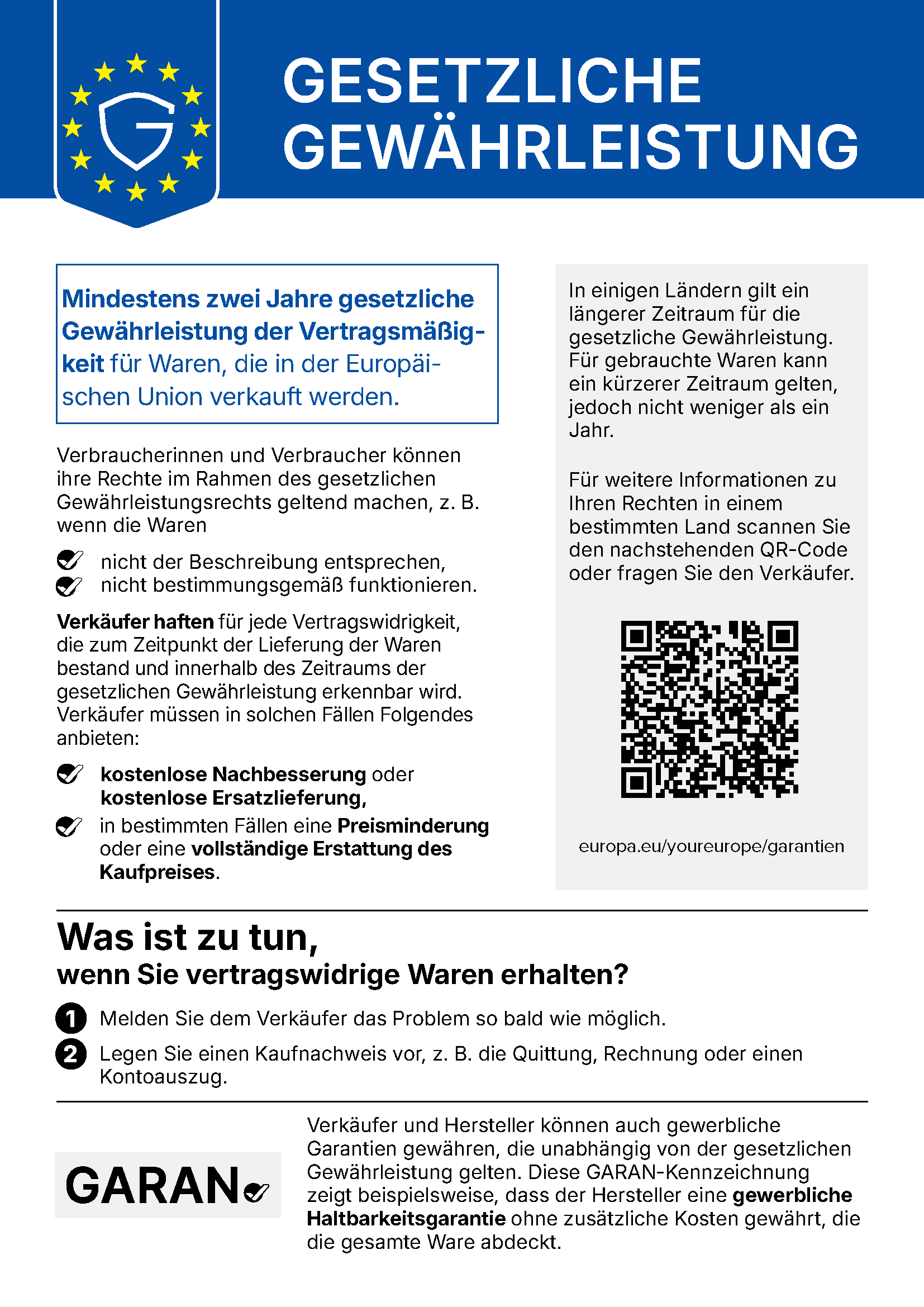
Important to note: The legal guarantee notice and the EU commercial guarantee label are purely mandatory disclosures; they are neither a seal of approval nor a marketing tool. They do not replace your Terms and Conditions or your cancellation policy, but rather supplement them with standardized information that is uniform across the EU. Anyone seeing both labels for the first time might mistake them for identical graphics, but they are two distinct labels with different scopes of application and different design rules.
Legal guarantee or commercial guarantee: What's the Difference?
Many customers lump legal and commercial guarantees together, but the two can be clearly distinguished: A legal guarantee is a legal right that automatically applies for at least two years with every purchase of goods. A commercial guarantee is a voluntary additional benefit, usually provided by the manufacturer, that goes beyond statutory rights. The EU aims to clear up this very confusion with the new label: Consumers should be able to see at a glance which rights they are already entitled to by law and what the manufacturer is providing voluntarily.
Who will be affected starting September 27, 2026?
The provisions take effect immediately as EU law, without a transition period established by national law. The following are affected:
- All businesses that sell goods to consumers, regardless of company size
- New and used items alike
- Third-party providers on marketplaces such as Amazon or eBay, because what matters is who becomes the buyer’s contractual partner
- brick-and-mortar retail, as well as contracts concluded via email or telephone
This does not apply to purely B2B stores or listings in which no physical goods change hands, such as digital content, SaaS, or traditional services.
How and where should the labels appear in the online store?
Design and content
Both legal guarantee notices and commercial guarantee labels are strictly regulated across the EU in terms of layout, color, and content. Retailers are not permitted to shorten them or adapt them to their individual store designs. For commercial guarantee labels, only the manufacturer, model, and duration may be listed; the rest of the content is also fixed and cannot be changed.
Color and minimum size
The color and minimum size depend on the channel where you display the label. In an online store, the label must be displayed in color. The regulation does not specify a fixed minimum size in millimeters or pixels in that context. However, if the contract is concluded not through a store’s user interface but, for example, via email or in a physical store, the label may also appear in black and white, but it must comply with a fixed minimum format:
- Online store: Color required; no minimum size required
- Email: color or black-and-white, minimum size DIN A4
- Retail store: color or black-and-white, minimum size DIN A4
- Online store: Color required; no minimum size specified
- Email: color or black-and-white, minimum size 95 x 100 mm
- Physical store: color or black-and-white, minimum size 95 x 100 mm
Formats larger than the minimum size are expressly permitted by the warranty label.
The European Commission provides the graphic files for legal guarantee notices and commercial guarantee labels in all official languages, in both color and black-and-white versions. For multilingual online stores, this means you should display the label in the language selected for your store.
Placement in the online store
The legal guarantee notice must be easily recognizable before the contract is concluded—for example, on the product detail page or during checkout—but it does not have to appear on every individual item. Whether it may be displayed in a nested format—that is, only appearing in full size after a click or mouseover—is currently a matter of legal debate: the text of the regulation argues against it, while the European Commission’s practical guidelines support it. Until the matter is clarified, displaying it in full and directly visible is the safer choice.
The commercial guarantee label, on the other hand, is product-specific and must appear on the respective item detail page; a note in the checkout process alone is not sufficient here. Unlike the legal guarantee notice, the regulation expressly permits nested display in this case.
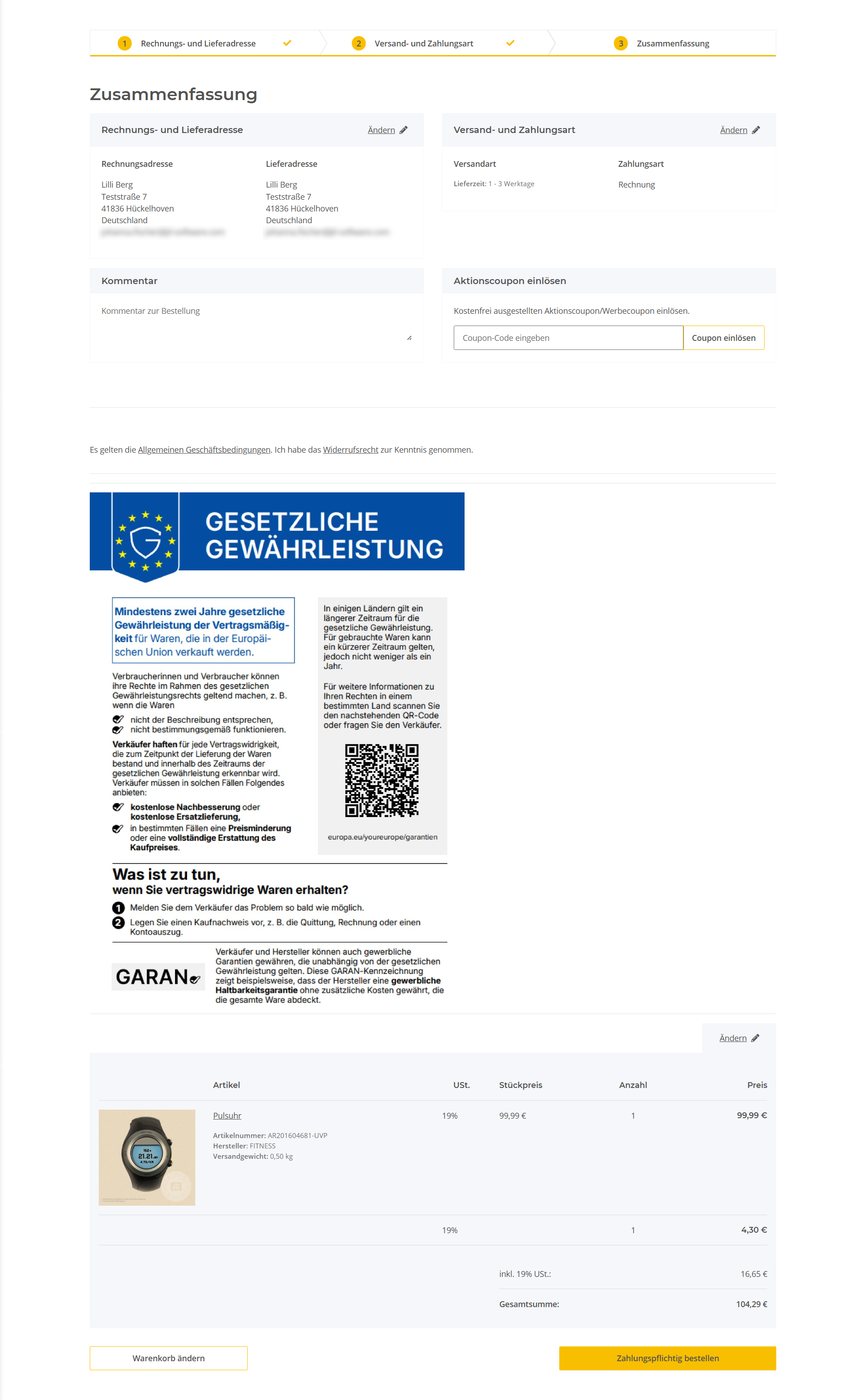
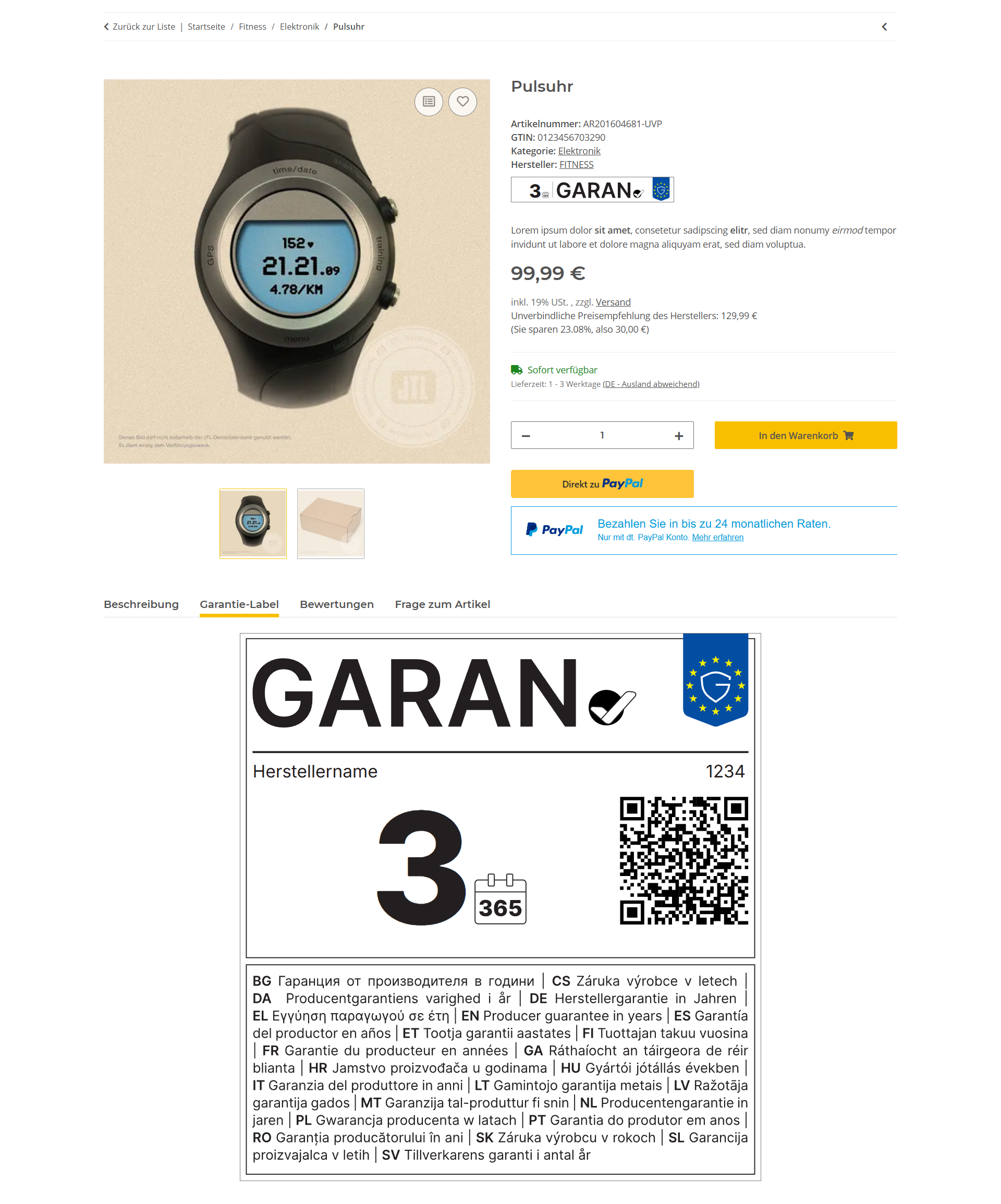
The following overview will give you a general idea of which labels apply to which sections of the store:
Order confirmation
Both legal guarantee labels and commercial guarantee labels must also be included in the order confirmation, which you, as the store operator, provide to your customers on a durable data medium—such as via email with an attachment.
What are the consequences of missing or incorrect labels?
If a label is missing, incomplete, or if a guarantee label is used without an actual manufacturer’s warranty, this raises competition law issues: It could result in cease-and-desist letters from competitors or trade associations. Because the requirements are uniform across the EU, violations are also easy to verify.
Shop 5.8: EU label directly from your store
If you use Shop by JTL, you can generate the new labels directly from within the shop starting with version 5.8.0. You maintain the warranty data centrally in your ERP using the function attributes for warranty years, manufacturer, and model ID. During the shop synchronization, the appropriate labels are automatically generated from this data: in color and in the correct language, with an English fallback for languages that haven’t yet been configured.
You decide where the labels appear: Using new global settings, you can specify whether and how the commercial guarantee label is visible on category pages, item detail pages, in the basket, and checkout. You can also enable a dedicated warranty page for the legal guarantee notice – accessible at all times via the legal information section – which includes a scannable QR code and a language version that matches the official EU information.
So when you update to Shop 5.8, you’ll be all set for September 27 and can look forward to the EU legal guarantee notice and EU commercial guarantee label requirement with confidence—without needing an additional plugin.
Here's what else Shop 5.8 has to offer:
Checklist: How to prepare your shop for the EU legal guarantee notices and the commercial guarantee labels

Conclusion
The EU regulation itself does not introduce new warranty or guarantee obligations, but it does impose new requirements regarding how they are presented. Some questions of interpretation remain unresolved, and it cannot be ruled out that the European Commission will further revise its practical guidelines. It’s therefore best to take a two-pronged approach: start preparing the content early so that your product range and warranty information are reviewed in a timely manner, and simultaneously move forward with the technical implementation, such as by updating to Shop 5.8. This way, you’ll be fully prepared for the September 27, 2026, deadline regarding warranty and guarantee labels, without having to make last-minute corrections.
Frequently asked questions about the EU legal guarantee notice
Effective September 27, 2026, directly as EU law without a separate national transition period.
The legal guarantee notice provides information about statutory rights regarding product defects and is required for virtually every product. The commercial guarantee label indicates a voluntary manufacturer’s warranty of more than two years and is used only if such a warranty actually exists.
No, only if the manufacturer offers a free warranty of more than two years for this product and provides you with the relevant information.
No. The design, colors, and content are standardized across the EU; for the commercial guarantee label, you may only enter the manufacturer, model, and warranty period.
Yes. What matters is who becomes the customer’s contractual partner, not who operates the platform.
Yes, the labels must be included in the order confirmation, which should be sent on a permanent data medium, such as email.
There is a risk of receiving cease-and-desist letters under competition law from competitors or industry associations, as this is a statutory obligation to provide information.
As of August 2026. This article does not constitute legal advice and is not a substitute for an individual review by a law firm.